Sunday, February 14, 2016

Christian Hans Monson: Norwegian Mormon Convert, Handcart Pioneer, Temple Builder


Christian Hans Monson
Compiled by Devan Jensen


Born:

June 16, 1837; Fredrikstad, Norway

Died:

September 23, 1896; Richmond, Cache, Utah

Immigration Date:

1857, Christian Christiansen Handcart Company


A Narrative of the Life of Christian Hans Monson
Source: History by Hazel Kofoed, a granddaughter of Christian Hans Monson.
Christian Hansen (son of Hans) was born June 16, 1837, in Fredrikstad, Norway. He was the son of Hans Monsen and Berthe Nilsdatter (or Bertha Nielson), whose family consisted of two sons, Niels and Christian, and three daughters, Ann, Elizabeth, and Maren.

Hans Monsen was at one time warden of the old state prison at Frederikstad. During his term of office in the year of 1851, there were three Mormon missionaries imprisoned for preaching the gospel in Norway. These missionaries remained so long that the warden became indifferent regarding them and in due time became a little careless in his duty and allowed his son Christian to carry food into the cells for the missionaries.

It seems that young Christian was by nature rather inquisitive, and due to his frequent visits, he soon became rather intimate with the missionaries and was finally converted by them to the divine mission of Joseph Smith, the Prophet. So strongly was he impressed with the testimonies borne by the servants of God to him, and the testimony he had received through diligent prayer to the Lord, that he finally requested the elders to baptize him.

Obviously, this could not be done while they were in prison. They requested their young convert to be patient until their prison term had expired, but this did not satisfy him. Finally he suggested that he get the keys some night and let them out long enough to perform the ordinance of baptism and the laying on of hands for the reception of the gift of the Holy Ghost, and thus confirm him a member of The Church of Jesus Christ of Latter-day Saints. When this was done, they returned to their cells and he locked them in again.

Some time later, the missionaries, having served out their sentence, were released from prison. But the conversion of the boy, who was only fourteen years of age, still remained a secret, at least as far as his parents were concerned. However, he soon told them the news, he was so happy in the fact that he firmly believed, that God in answer to his prayers, had opened the way for him to hear God’s servants proclaim the everlasting gospel as revealed to the Prophet Joseph Smith. He confided to his father the story of the knowledge he had received, and the consequent ordinance which had been performed for and in his behalf by the elders.

Christian was sorely disappointed regarding the reaction of his father. Instead of kind expressions of interest and approval of the research made by his youngest child, his father seemed to have lost sight of everything that savored parental love, and allowed the spirit of the adversary to take possession of him. While under that influence, he administered a severe punishment on his son and ordered him to leave home and never return again.

Upon leaving his home, where he left his parents, his brother and sisters, he went to the city of Drammen, Norway. He there entered the employ of a contractor as an apprentice in carpenter and joiner. He took an elementary course in architecture. In these branches he served six years as an apprentice, for which he received his food and clothing. His employer, however, permitted him to make small trinkets, such as work boxes; these he sold as best he could and from this source he made a little money, which he saved, in hope that at some future time he would be able to emigrate to Zion.
Early in the spring of 1857 he arranged to emigrate, working his passage across the North Sea and the Atlantic Ocean. The company of emigrants with which he sailed left Liverpool, England, April 25, 1857, on the sailing ship Westmoreland. There were 544 Saints, mostly Scandinavian, under the direction of Mathias F. Cowley.

Many Scandinavians took their fathers' last name when immigrating. Christian eventually settled on the name Christian Hans Monson. The immigrants arrived in Philadelphia on May 31, 1857, and went from there to Iowa City by train, reaching there June 9, 1857. Here the emigrants were divided into two companies under the direction of Brother Cowley, the Scandinavian Saints going with a handcart company under the direction of Christian Christiansen. During their journey across the plains, they had food shortage, sickness, and hardships. Both companies arrived in Salt Lake City on September 15, 1857.

The US Army under Albert Sidney Johnston was on its way to Utah on September 15, 1857, on the Oregon route across the plains, which was on the opposite side of the Platte River from the trail used by the Mormon emigrant train. In September, Governor Brigham Young declared Utah under martial law, and forbade the army troops entering Utah. Men were enlisted to go to the mountain passes to keep them from entering the valley. Christian was sent into Echo Canyon as a guard.

After his guard duty was over, he located in Lehi, Utah.

Brigham Young met with the army officials and a satisfactory understanding was had. The army entered the valley peacefully, and Christian received some employment occasioned by the army troops coming into the Salt Lake Valley.

In 1860, when Cache Valley was being settled, Christian was called by the Church authorities to move to Logan, where he could assist with his trade in building homes and other buildings for the pioneers in the valley. Several buildings still remain that he built. Among them is the building occupied by the First National Bank of Logan, which was built for ZCMI. He purchased from the Taylor Romney Lumber Company, in Salt Lake City, a planing machine that was brought across the plains by ox team, and set it up in Logan, Utah.

In 1878, he was called to fill a mission in Sweden, and while there he went back to see his old home in Norway and visit his people, but was not received very kindly. He finished his mission in Sweden, returning home in 1880.

He was called to help build up Richmond, Utah, and Franklin, Idaho. In 1889, he built and operated a sawmill in Franklin. He lived there until his death on September 23, 1896, leaving a very large family.

He was the second man to own and operate a sawmill in Utah. He helped to build the St. George Temple, Manti, Logan, and Salt Lake Temples.
Wives’ Names
Marriage Date
No. of Children
Nielsene Krutzbach
June 29, 1858
2
Annie Catherine Peterson
April 26, 1861
4
Ellen Manson
March 16, 1867
11
Karren Marie Olsen
May 2, 1870

Ella Jensen
January 5, 1874
10
Vendla Jacobsen
March 15, 1883
3


Christian Hans Monson

(born Christen Hansen), 1837–96

Source: Susan Easton Black, Shauna C. Anderson and Ruth Ellen Maness, Legacy of Sacrifice: Missionaries to Scandinavia, 1872–94 (Provo, UT: Religious Studies Center, 2007).

Residence: Richmond, Cache Co., Utah
Arrival date in Copenhagen: 20 November 1878
Missionary labors: Göteborg Conference
Departure date from Copenhagen: 5 July 1880
Name of departure ship: Cato
Birth date: 16 June 1837
Birthplace: Stora Boeplads, Tune, Østfold, Norway
Father: Monsen, Hans
Mother: Nielsdatter, Berte
Spouse: Kruetzback (Kredsbank), Nielsene Olsen, Marriage date: 29 June 1858, Marriage place: Lehi, Utah Co., Utah
Spouse: Peterson, Anna Catherine, Marriage date: 26 April 1861, Marriage place: Salt Lake City, Salt Lake Co., Utah
Spouse: Mansson, Ellen Persson, Marriage date: 16 March 1867, Marriage place: Salt Lake City, Salt Lake Co., Utah
Spouse: Olsen, Karen Maria, Marriage date: 2 May 1870
Spouse: Jenson, Elna (Ella), Marriage date: 5 January 1874, Marriage place: Endowment House, Salt Lake City, Salt Lake Co., Utah
Spouse: Jacobsson, Wendla (Vendla), Marriage date: 15 March 1883, Marriage place: Salt Lake City, Salt Lake Co., Utah
Death date: 23 September 1896
Death place: Richmond, Cache Co., Utah
Burial place: Richmond, Cache Co., Utah

Christian’s father was a woodcutter by trade. He was industrious and hardworking, and he expected everyone around him to be the same. He had a violent temper, and Christian recalled being “mortally afraid” of his walking cane. However, when he was in good humor, Christian enjoyed sitting and talking to him as he smoked his long-stemmed pipe (see Skidmore, “Biographical Sketch of the Life of My Father Christian Hans Monson as I Knew Him,” 1).

Christian was baptized on 4 April 1853 by Svend Larsen. At the time, he was an employee of the Fredrikstad prison. He recalled carrying meals to the elders who were imprisoned for preaching. In this process, an elder asked him why he abused and tormented him, for “so persecuted they the Christ and his followers.” The prisoners set Christian to thinking. One night during the winter of 1852, he released his prisoners. Together they walked to the fjord, where Christian was secretly baptized, after which the elders returned to their prison cell (see Skidmore, “Biographical Sketch of the Life of My Father Christian Hans Monson as I Knew Him,” 2; Skidmore and Horne, “Immigrant Pioneers: Christian Hans Monson,” Daughters of Utah Pioneers, Lesson for October 1984, 41–53; Roberts, “Love Is Its Own Reward,” New Era, February 1978, 6–7).

Christian was whipped by his father for being baptized and told never to return. He left home and labored as a local missionary in Drammen, Buskerud County, Norway. At that time, he was five feet nine inches and weighed 190 pounds. He had blue eyes, a fair complexion, brown hair, and a beard (see Skidmore and Horne, “Immigrant Pioneers: Christian Hans Monson,” Daughters of Utah Pioneers, Lesson for October 1984, 41–44).

He was ordained an elder on 8 September 1856. He began his emigration to America on 9 August 1857. He voyaged from Liverpool to the United States aboard the Westmoreland. He crossed the plains in the Christian Christiansen handcart company to reach the Salt Lake Valley (see Jenson, History of the Scandinavian Mission, 236). Christian settled in Lehi, Utah County, before moving to Logan, Cache County, and finally Richmond, Cache County. He was called from Richmond to serve as a guard in Echo Canyon during the Utah War (see Esshom, Pioneers and Prominent Men of Utah, 1042). After the threat of war passed, he was endowed on 26 October 1861 in the Endowment House in Salt Lake City.

He married Nielsine Kruetzback, a widow fourteen years his senior. This marriage ended in divorce. After the divorce, Christian accepted a mission call to Scandinavia in 1878. He arrived in Copenhagen on 20 November 1878 and was assigned to labor in the Göteborg Conference. After completing an honorable mission, he departed from Copenhagen on 5 July 1880 aboard the steamer Cato with 346 emigrating Latter-day Saints and other returning missionaries (see Jenson, History of the Scandinavian Mission, 243).

On 23 June 1888, the First District Court of Ogden sentenced Christian to six months’ imprisonment and a one-hundred-dollar fine for unlawful cohabitation. He was discharged from the penitentiary on 23 December 1888 (see Jenson, LDS Church Chronology, June 23, 1888; December 23, 1888).

After his discharge, he served as president of the Thirty-ninth Quorum of the Seventy and as a temple worker in St. George. He is remembered as being a pioneer builder and lumberman. He is credited with assisting in the construction of the Salt Lake, St. George, Manti, and Logan Temples (see Skidmore and Horne, “Immigrant Pioneers: Christian Hans Monson,” Daughters of Utah Pioneers, Lesson for October, 1984, 49–50).

In his later years, he moved to Franklin County, Idaho, where he set up a lumber mill. He operated the mill until his health failed. Christian died in 1896 from jaundice and gallstones in Richmond at age fifty-nine (see Skidmore and Horne, “Immigrant Pioneers: Christian Hans Monson,” Daughters of Utah Pioneers, Lesson for October 1984, 51).

Wednesday, December 2, 2015

Henry Wells Jackson Plaque Dedicated by Elder Steven E. Snow

Left to right: Paul A. Hoffman (attorney), Devan Jensen (executive editor at BYU Religious Studies Center), Katherine Brimhall (Daughters of Utah Pioneers), Jackson Barlow (Eagle Scout in Alpine, Utah), and Elder Steven E. Snow (Church Historian and Recorder, November 11, 2015.

Elder Steven E. Snow, Church Historian and Recorder, dedicated a new Daughters of Utah Pioneers plaque to Lt. Henry Wells Jackson, Utah's only known Civil War fatality. About a hundred people gathered for the ceremony at the Pioneer Memorial Museum in Salt Lake City on November 11, 2015. The plaque is attached to a Civil War Monument located across the street from the museum on the southwest corner of the Utah State Capitol grounds. This was an Eagle Scout project by Jackson Barlow of Alpine, Utah, to honor his namesake ancestor.

Jackson, Dona, and David Barlow next to Henry Wells Jackson plaque at Civil War Monument on Utah State Capitol grounds.
Following are links to articles about how the plaque was researched and came to be:


Sunday, November 29, 2015

"Shall We Not Go On in So Great a Cause?"

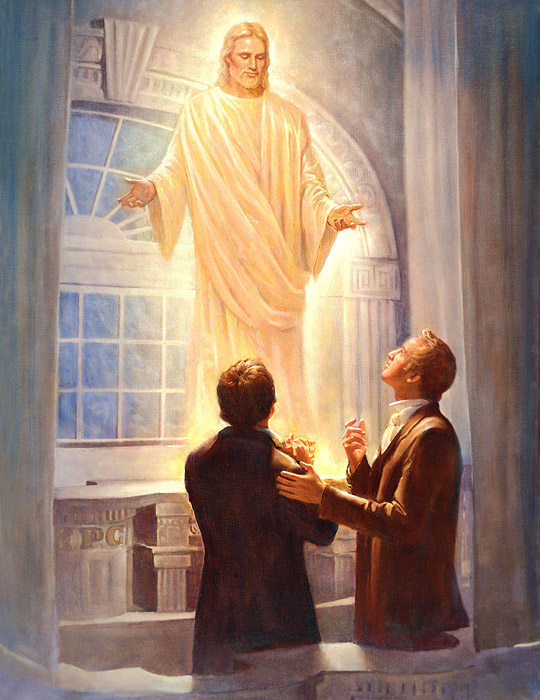
Del Parson, Christ Appears to Joseph Smith and Oliver Cowdery in the Kirtland Temple.
In 1833 the Latter-day Saints (nicknamed Mormons) experienced great trials and hardships in Ohio and Missouri but chose to sacrifice their time and money the build the house of the Lord in Kirtland, Ohio. In 1836 Joseph Smith Jr. prayed mightily to dedicate the temple as a place for the Son of Man "to manifest himself to his people" (see Doctrine and Covenants 88:5). He prayed that the Saints might be armed with power and blessed by angels (see Doctrine and Covenants 88:22). Many there testified that they experienced divine manifestations, including a vision of the Savior Jesus Christ and appearance of several angels who restored priesthood keys (see Doctrine and Covenants section 110). Historian Keith W. Perkins has written here about the construction, dedication, and miraculous events. Historian Steven C. Harper detailed the historical context here.

After the Saints reluctantly left their beloved temple, they were commanded to build another in Nauvoo. There God revealed that ordinances are vital not only for the living but also the dead who had not received that opportunity during their lifetime. These revelations reaffirmed New Testament teachings and gave new emphasis. For example, in Luke 4:18, Jesus Christ quoted the messianic promise of opening the prison to set the captives free (see Isaiah 61:1). He later taught the Pharisee Nicodemus, "Except a man be born of water and of the Spirit, he cannot enter into the kingdom of God" (John 3:5). Church members, believing in the salvational nature of the Atonement of Jesus Christ and the command to be baptized, began performing proxy baptisms for deceased ancestors and others, trusting that the dead could be released from prison (see 1 Peter 4:6). As the Apostle Paul said, "Else why are they then baptized for the dead?" (1 Corinthians 15:29).

On January 19, 1841, Joseph Smith recorded an injunction to build a temple in Nauvoo and to have the Saints begin baptizing by proxy when it was ready (see Doctrine and Covenants 124). He compared baptisms for the dead to welding links that bind us to our ancestors. Within the context of the challenges faced in Nauvoo, he wrote a stirring letter of encouragement about performing baptisms for the dead: "Shall we not go on in so great a cause? Go forward and not backward. Courage, brethren; and on, on to the victory! Let your hearts rejoice, and be exceedingly glad. Let the earth break forth into singing. Let the dead speak forth anthems of eternal praise to the King Immanuel, who hath ordained, before the world was, that which would enable us to redeem them out of their prison; for the prisoners shall go free" (Doctrine and Covenants 128:23).

Fast forward to 2015. Over the Thanksgiving holiday, several of our extended family members visited the Boise Idaho Temple and performed baptisms for the dead. What a joy that was! Today our son Jacob spoke in church about how temple work and family history work go hand in hand, sharing gratitude for his mom's help in researching. Shall we not go in in so great a work? Let's go forward and not backward. Courage, and on to the victory! Let the dead speak forth anthems of eternal praise to the King Immanuel!

Wednesday, October 21, 2015

"The Law of Love," by Gandhi


It takes a fairly strenuous course of training to attain to a mental state of nonviolence. In daily life it has to be a course of discipline though one may not like it, like, for instance, the life of a soldier. But I agree that, unless there is a hearty cooperation of the mind, the mere outward observance will be simply a mask, harmful both to the man himself and to others. The perfect state is reached only when mind and body and speech are in proper coordination. But it is always a case of intense mental struggle. It is not that I am incapable of anger, for instance, but I succeed on almost all occasions to keep my feelings under control. What, ever may be the result, there is always in me a conscious struggle for following the law of nonviolence deliberately and ceaselessly. Such a struggle leaves one stronger for it. 

Nonviolence is a weapon of the strong. With the weak it might easily be hypocrisy. Fear and love are contradictory terms. Love is reckless in giving away, oblivious as to what it gets in return. Love wrestles with the world as with the self and ultimately gains mastery over all other feelings. My daily experience, as of those who are working with me, is that every problem lends itself to solution if we are determined to make the law of truth and nonviolence the law of life. For truth and nonviolence are, to me, faces of the same coin.

Whether mankind will consciously follow the law of love I do not know. But that need not perturb us. The law of love will work, just as the law of gravitation will work, whether we accept it or not. Just as a scientist will work wonders out of various applications of the law of nature, even so a man who applies the law of love with scientific precision can work greater wonders.

Excerpt from Mohandas K. Gandhi, "The Law of Love," The Hindu, November 8, 1926.

Friday, September 4, 2015

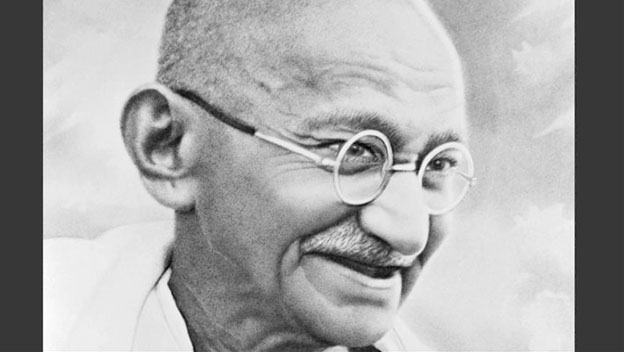
Gandhi's Message to Us

Shy, tongue-tied, twenty-three-year-old Mohandas Gandhi left India for South Africa as an attorney. With little knowledge of South African law, he found himself in over his head with a particularly difficult case involving accusations of bookkeeping impropriety. He chose to immerse himself in the case and learn bookkeeping. Then he made a life-changing decision to help both parties work through their intense emotions to find reasonable solutions that would satisfy all. 

Regarding this event, he wrote in 1927: "I had learnt the true practice of law. I had learnt to find out the better side of human nature and to enter men's hearts. I realized the true function of a lawyer was to unite parties riven asunder. The lesson was so indelibly burnt into me that a large part of my time during the twenty of my practice as a lawyer was occupied in bringing about private compromises of hundred of cases. I lost nothing thereby--not even money, certainly not my soul" (Eknath Easwaran, Gandhi the Man: The Story of His Transformation [Tomales, CA: Nilgiri, 1997], 22).

He chose selfless service as the course of his life, primarily serving the downtrodden Indian community of South Africa. "Do not worry in the least about yourself, leave all worry to God," he summarized as the main message of all religions. "He who devotes himself to service with a clear conscience, will day by day grasp the necessity for it in greater measure, and will continually grow richer in faith" (29).

About this time of his life, cruelty struck. While traveling by train to the region of Natal, he was told by a European traveler to vacate his first-class seat and join the other Indians in third-class. Gandhi asserted that he had a right to sit in his reserved seat, but the man called on the police and Gandhi was thrown off the train without his luggage.

That night at Maritzburg station, cold and without his luggage, Gandhi pondered the inhumanity of man and the plight of the Indian people in South Africa. He resolved to change the situation the way God would--he would resist violence firmly, but without violence. He determined that love would triumph over hatred. Years later, when asked what event had transformed his life the most, he told the story of that night because he had decided "never to yield to force and never to use force to win a cause" (42).

He called the quest Satyagraha ("holding on to truth" or "soul-force"). Satya means "truth" or "that which is" (48). To resist evil, falsehood, and injustice, Gandhi chose to hold fast to goodness, truth, and justice. Emptying himself of desire for retribution or even the basic physical desires of the flesh (food, clothing, and comfort), he chose selfless love over the ABC's of the natural man: Anger, Bitterness, and Contention.

"Select your purpose," he urged others, "selfless, without any thought of personal pleasure or personal profit, and then use selfless means to attain your goal. Do not resort to violence even if it seems at first to promise success; it can only contradict your purpose. Use the means of love and respect even if the result seems far off or uncertain. Then throw yourself heart and soul into the campaign, counting no price too high for the welfare of those around you, and every reverse, every defeat, will send you deeper into your own deepest resources" (49).

Pure love became his goal. "Love never claims, it ever gives," he taught. "Love ever suffers, never resents, never revenges itself." Although love may be a difficult choice, he invited us to "start where you are. If you can't love the Viceroy, or Sir Winston Churchill, start with your wife, or your husband, or your children. Try to put their welfare first and your own last every minute of the day, and let the circle of your love expand from there" (126).

Gandhi said simply, "My life is my message." And so it is with all of us. 


I close with an experience shared by some dear friends. They were teaching their young children about service and asked, "Who is the happiest person you know?"

"Brother Jensen" was their answer.

"Why do you think he's so happy?" the parents asked.

"Because he serves people."

"Exactly!" they said.

But, like any other person, I have good days and bad. In the end, I hope the good outweighs the bad, and my life will be remembered for joyful service. Because our life is our message.

Sunday, August 23, 2015

Beyond Drama: Victims, Villains, and Heroes


Gary Harper wrote a profound article called "Conflict Drama: Victim, Villain or Hero?"

A Drama Triangle

As in fairy tales or movies, we often tell our own story with three types of characters: victim (damsel in distress or innocent youth); villain (witch, giant, or dragon); and hero (prince or princess). We tend to cast ourselves in the role of innocent victim or noble hero and define ourselves in opposition to a villain. Casting ourselves in these roles may, however, hinder getting what we really want.


Innocent victim
"Because conflict involves an attack or threat to us or our needs, we feel victimized. With the victim role comes a belief in our innocence as well as a feeling of powerlessness. . . . Although some people suffer in silence, we often express our frustration by complaining about the situation and blaming the person we see as responsible for our plight (the villain)."

Noble hero
"Though we initially experience conflict from victim mode, we may shift to hero mode to protect ourselves, defend our interests and even the score. This role encompasses courage and action, selflessness and nobility. . . . There is a darker side to the hero role, however, when righteousness becomes self-righteousness. In the pursuit of justice, the hero slays or captures the villain. When we agree that the hero's cause is just, we condone and even applaud these aggressive behaviors. We justify our own aggressive, hurtful behavior by telling ourselves, 'They had it coming.'"

Getting Stuck in Our Story

"When we see ourselves as victims or heroes, we automatically create villains in our conflicts. When we see (and treat) someone like a villain, they in turn feel victimized by us--and see us as the villain. Behaviors they consider self-defense, we experience as attacks and further evidence that we cannot trust or work with them. And the walls of judgment and justification thicken on both sides." These behaviors lead to a win-lose or lose-lose situation. But we can look for win-win solutions.

Casting New Roles

"We can shift our perspective to seek resolution instead of victory. We can explore possibilities that allow both sides to get what they need."

From passive victim to assertion
"We begin by taking responsibility for our feelings and reactions in conflict. We do not have to deny or devalue our feelings or needs, but can accept them as our own. After all, whose problem is it if you go home frustrated with your boss at the end of a workday? Who 'owns' the problem? (Hint: Your boss may be sleeping like a baby as you lie awake endlessly replaying the events of the day)." . . . Similarly, we can ask directly for what we need instead of quietly complaining to others about our plight. This is uncomfortable, yet empowering. It's uncomfortable because we can no longer blame others and refuse to change, empowering because we become an active participant in shaping our life."

From hero to problem solver
"The role of hero can be as unproductive as that of victim in resolving conflict. This self-righteous mindset condones our attack on the villain as justice. Attack is met with counterattack; the conflict persists and usually escalates. Our ego fuels the need to be right and we become attached to a specific outcome. At this point, the conflict often becomes a power struggle. We can address and resolve conflict much more productively if we let go of the need to be 'right' and focus instead on ways to get our needs met. This opens up possibilities we might otherwise ignore. The energy devoted to a win-lose power struggle can instead be applied to problem solving. This approach is often referred to as 'separating the people from the problem.'"

From adversaries to partners
"When we live on the drama triangle, we see the other person as our adversary--the villain. If only they would change, we reason, things would be fine. They stand between us and happiness. Ironically, they are usually thinking the same thing about us. To resolve conflict, we need to relinquish our roles as victim, villain, and hero and work with the other person to solve the problem. If we need a villain, let it be the problem, not the person." So, rather than talking about the person as the problem, we can talk with the person about possible solutions. Our enemy can then become our partner, or even our friend.

Wednesday, April 22, 2015

Parable of the Unforgiving Servant

“The kingdom of heaven is like a king who wanted to settle accounts with his servants. As he began the settlement, a man who owed him ten thousand bags of gold was brought to him. Since he was not able to pay, the master ordered that he and his wife and his children and all that he had be sold to repay the debt.  At this the servant fell on his knees before him. "Be patient with me," he begged, "and I will pay back everything." The servant’s master took pity on him, canceled the debt and let him go. 

When that servant went out, he found one of his fellow servants who owed him a hundred silver coins. He angrily grabbed him and began to choke him. "Pay back what you owe me!" he demanded. His fellow servant fell to his knees and begged him, "Be patient with me, and I will pay it back."  But the first servant refused. Instead, he had the man thrown into prison until he could pay the debt.

When the other servants saw what had happened, they were outraged and went and told their master everything that had happened. Then the master called the servant in. "You wicked servant," he said, "I canceled all that debt of yours because you begged me to.  Shouldn’t you have had mercy on your fellow servant just as I had on you?" In anger his master handed him over to the jailers to be tortured, until he should pay back all he owed. Jesus taught, “This is how my heavenly Father will treat each of you unless you forgive your brother or sister from your heart.” (Matthew 18:21-35)

Elsewhere, Jesus said, “For if you forgive others their trespasses, your heavenly Father will also forgive you, but if you do not forgive others their trespasses, neither will your Father forgive your trespasses" (Matthew 6:14-15). To forgive is to "let it go," to move on, and to stop bringing it up over and over. The choice to forgive blesses us directly, as the following article shows.

"Choosing to Forgive" (Jan. 2014 Ensign) 

By Benjamin F. Call

As a cardiologist, I attended a conference for physicians several years ago about the importance of forgiveness. I learned there of scholarly studies showing that choosing to forgive leads to better health, increased optimism, and better relationships with others.1 In my study of the words of God, I have learned that forgiving others also brings great spiritual blessings, including peace and hope. Perhaps the most important of these blessings is that as we forgive others, we can be forgiven of our own sins. The Lord teaches us that forgiving others is a universal commandment—we are “required to forgive all men” (D&C 64:10).

Yet even when we are aware of the importance of forgiveness, it may be difficult to forgive. Sometimes we allow pride, fear, resentment, or bitterness to discourage us and block our ability to feel hope. But the courage to forgive comes to those who put their faith and trust in the Lord. With His help, we can find the strength to forgive others—whether the wrongdoer has committed a serious sin or an unintended offense. Here are a few suggestions.

Understand what forgiveness is. To forgive is to pardon an offense. It is to let go of blame for a past hurt. It is to release a great burden. It is to move ahead with life. In his last general conference address, President James E. Faust (1920–2007), Second Counselor in the First Presidency, cited this definition of forgiveness: “Forgiveness is freeing up and putting to better use the energy once consumed by holding grudges, harboring resentments, and nursing unhealed wounds. It is rediscovering the strengths we always had and relocating our limitless capacity to understand and accept other people and ourselves.”2

Understand what forgiveness is not. Forgiveness does not require condoning a wrong, nor does it require allowing a harmful behavior, such as an abusive relationship, to continue. Also, forgiveness is not forgetting—if the offense wounded you enough to require forgiveness, you will likely have a memory of it. As author Lewis B. Smedes explained, “Forgiving what we cannot forget creates a new way to remember. We change the memory of our past into a hope for our future.”3

Understand that failing to forgive magnifies the pain. Pain, disappointment, and injustice touch every life, often wounding tender hearts. At such times it may seem natural to blame another for things that have gone wrong. When we seek to place blame, however, we actually magnify our pain. This is because the act of blaming focuses our minds and hearts on the past, causing us to relive the hurt and harbor emotional and spiritual injuries that might otherwise heal. Resisting the urge to place blame is key to our ability to forgive.

Elder Hugh W. Pinnock (1934–2000) of the Seventy taught: “Of course, heartache and pain can be spilled upon us by dishonest, manipulative, or unkind people. Accidents happen that can inflict terrible pain and sometimes lifetime disability. But to judge, blame, and not forgive always intensifies the problem. It pushes healing further into the future.”4

In order to fully heal, we need to accept responsibility for our reaction to whatever happens. Taking responsibility for the condition of our hearts allows us to regain control of our lives. Although we cannot always control what happens to us, we can always choose our response. Herein lies the power of our agency.

Pray for humility. Humility is the opposite of pride, which is the primary obstacle in our effort to forgive. Pride causes us to blame others for our misfortunes and to shift responsibility for what happens to us onto anyone but ourselves. But the Lord promises, “If they humble themselves before me, and have faith in me, then will I make weak things become strong unto them” (Ether 12:27). According to our humility and faith, the Lord will help us stop blaming others and truly forgive.

Express gratitude. Expressing gratitude invites the Spirit more fully into our lives, which can soften and change our hearts. Consider keeping a journal of things you are grateful for. Look for manifestations of God’s love each day. As you cultivate an attitude of gratitude, you may find that you can even identify reasons to be grateful for your trials.

Be patient. Forgiving when your pain is great may take time. A woman who was recovering from a  divorce received this wise counsel from her bishop: “Keep a place in your heart for forgiveness, and when it comes, welcome it in.”5 You can make room for forgiveness through earnest prayer, study, and contemplation. Feasting upon the words of Christ daily will also help you draw closer to Him and will bring great healing power into your life (see 2 Nephi 31:20; Jacob 2:8).

Leave the past behind. The past is written in stone and cannot be changed. Focus your energy on today, for today you have the power to choose to forgive.

Write it down. When we hold grudges, we keep our wounds alive and fresh. Writing down your feelings can help you move forward. You may find it helpful to record your perspective on the situation and then rewrite your story by retelling it using a loving and forgiving tone. This practice invites the spirit of forgiveness and can bring a sense of closure to grievances and hurt feelings.

Trust that God will be the perfect Judge. The Savior said, “I, the Lord, will forgive whom I will forgive, but of you it is required to forgive all men” (D&C 64:10). As we forgive, we must have enough faith to allow Christ’s judgment to be judgment enough. He will bring both mercy to the humble and justice to the wicked. Rest assured that God’s judgment will be thorough and fair.

Cast your burden on the Lord. Christ beckons, “Come unto me, all ye that labour and are heavy laden, and I will give you rest” (Matthew 11:28). Remember that in addition to taking upon Him the sins of the world, Christ took upon Him our pains and infirmities (see 2 Nephi 9:21; Alma 7:11–12; D&C 18:11). If you allow Him, He can make your burden light.

It can be difficult to find the strength to forgive, but the Savior and His Atonement make it possible. Truly, as we open our hearts to forgive others, we will be blessed with peace. Let us each embrace the healing power of forgiveness.

Notes
  1. See, for example, Michael E. McCullough, “Forgiveness as Human Strength: Theory, Measurement, and Links to Well-Being,” Journal of Social and Clinical Psychology 19, no. 1 (Spring 2000), 43–55.
  2. Sidney B. Simon and Suzanne Simon, as quoted in James E. Faust, “The Healing Power of Forgiveness,” Ensign, May 2007, 68.
  3. Lewis B. Smedes, The Art of Forgiving: When You Need to Forgive and Don’t Know How (1996), 171.
  4. Hugh W. Pinnock, “Now Is the Time,” Ensign, May 1989, 10.
  5. See James E. Faust, “The Healing Power of Forgiveness,” 68.

Battlefields to Temple Grounds: Latter-day Saints in Guam and Micronesia

Devan Jensen and Rosalind Meno Ram, editors of Battlefields to Temple Grounds: Latter-day Saints in Guam and Micronesia , thank our readers...