Showing posts with label love. Show all posts

Wednesday, October 21, 2015

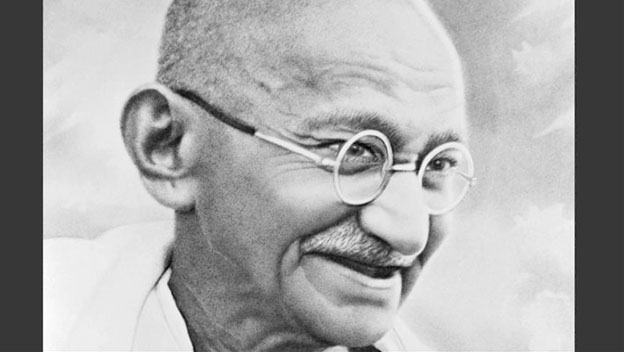
"The Law of Love," by Gandhi


It takes a fairly strenuous course of training to attain to a mental state of nonviolence. In daily life it has to be a course of discipline though one may not like it, like, for instance, the life of a soldier. But I agree that, unless there is a hearty cooperation of the mind, the mere outward observance will be simply a mask, harmful both to the man himself and to others. The perfect state is reached only when mind and body and speech are in proper coordination. But it is always a case of intense mental struggle. It is not that I am incapable of anger, for instance, but I succeed on almost all occasions to keep my feelings under control. What, ever may be the result, there is always in me a conscious struggle for following the law of nonviolence deliberately and ceaselessly. Such a struggle leaves one stronger for it. 

Nonviolence is a weapon of the strong. With the weak it might easily be hypocrisy. Fear and love are contradictory terms. Love is reckless in giving away, oblivious as to what it gets in return. Love wrestles with the world as with the self and ultimately gains mastery over all other feelings. My daily experience, as of those who are working with me, is that every problem lends itself to solution if we are determined to make the law of truth and nonviolence the law of life. For truth and nonviolence are, to me, faces of the same coin.

Whether mankind will consciously follow the law of love I do not know. But that need not perturb us. The law of love will work, just as the law of gravitation will work, whether we accept it or not. Just as a scientist will work wonders out of various applications of the law of nature, even so a man who applies the law of love with scientific precision can work greater wonders.

Excerpt from Mohandas K. Gandhi, "The Law of Love," The Hindu, November 8, 1926.

Friday, September 4, 2015

Gandhi's Message to Us

Shy, tongue-tied, twenty-three-year-old Mohandas Gandhi left India for South Africa as an attorney. With little knowledge of South African law, he found himself in over his head with a particularly difficult case involving accusations of bookkeeping impropriety. He chose to immerse himself in the case and learn bookkeeping. Then he made a life-changing decision to help both parties work through their intense emotions to find reasonable solutions that would satisfy all. 

Regarding this event, he wrote in 1927: "I had learnt the true practice of law. I had learnt to find out the better side of human nature and to enter men's hearts. I realized the true function of a lawyer was to unite parties riven asunder. The lesson was so indelibly burnt into me that a large part of my time during the twenty of my practice as a lawyer was occupied in bringing about private compromises of hundred of cases. I lost nothing thereby--not even money, certainly not my soul" (Eknath Easwaran, Gandhi the Man: The Story of His Transformation [Tomales, CA: Nilgiri, 1997], 22).

He chose selfless service as the course of his life, primarily serving the downtrodden Indian community of South Africa. "Do not worry in the least about yourself, leave all worry to God," he summarized as the main message of all religions. "He who devotes himself to service with a clear conscience, will day by day grasp the necessity for it in greater measure, and will continually grow richer in faith" (29).

About this time of his life, cruelty struck. While traveling by train to the region of Natal, he was told by a European traveler to vacate his first-class seat and join the other Indians in third-class. Gandhi asserted that he had a right to sit in his reserved seat, but the man called on the police and Gandhi was thrown off the train without his luggage.

That night at Maritzburg station, cold and without his luggage, Gandhi pondered the inhumanity of man and the plight of the Indian people in South Africa. He resolved to change the situation the way God would--he would resist violence firmly, but without violence. He determined that love would triumph over hatred. Years later, when asked what event had transformed his life the most, he told the story of that night because he had decided "never to yield to force and never to use force to win a cause" (42).

He called the quest Satyagraha ("holding on to truth" or "soul-force"). Satya means "truth" or "that which is" (48). To resist evil, falsehood, and injustice, Gandhi chose to hold fast to goodness, truth, and justice. Emptying himself of desire for retribution or even the basic physical desires of the flesh (food, clothing, and comfort), he chose selfless love over the ABC's of the natural man: Anger, Bitterness, and Contention.

"Select your purpose," he urged others, "selfless, without any thought of personal pleasure or personal profit, and then use selfless means to attain your goal. Do not resort to violence even if it seems at first to promise success; it can only contradict your purpose. Use the means of love and respect even if the result seems far off or uncertain. Then throw yourself heart and soul into the campaign, counting no price too high for the welfare of those around you, and every reverse, every defeat, will send you deeper into your own deepest resources" (49).

Pure love became his goal. "Love never claims, it ever gives," he taught. "Love ever suffers, never resents, never revenges itself." Although love may be a difficult choice, he invited us to "start where you are. If you can't love the Viceroy, or Sir Winston Churchill, start with your wife, or your husband, or your children. Try to put their welfare first and your own last every minute of the day, and let the circle of your love expand from there" (126).

Gandhi said simply, "My life is my message." And so it is with all of us. 


I close with an experience shared by some dear friends. They were teaching their young children about service and asked, "Who is the happiest person you know?"

"Brother Jensen" was their answer.

"Why do you think he's so happy?" the parents asked.

"Because he serves people."

"Exactly!" they said.

But, like any other person, I have good days and bad. In the end, I hope the good outweighs the bad, and my life will be remembered for joyful service. Because our life is our message.

Sunday, September 8, 2013

When Family Members Act Unlovable

Sometimes when our family members act unlovable, those are the times they need our love the most. Here I'm focusing on our relationship with teenagers when they sometimes act unlovable. When I say "act unlovable," I mean their outward behavior is sometimes an act--like good old high school drama. While inside, a teen may be desiring to belong to a family, sometime their outward behavior screams "I hate you!" In other words, while teens are forming their own values, separate from their parents' worldview, they can say things (intentionally or otherwise) that rile up parents' emotions, a kind of "I-dare-you-to-stay-calm-after-I-say-this" attitude. Why do they do this? Often while they are developing their own worldview, they experiment by bouncing controversial statements off a parent. Those are the times when we, as parents, can choose patience in order to prevent permanently damaging the relationship.

One way to not blow a gasket is to remember how much we love them and to focus on the relationship, using "not" statements to clarify our real intent. If a child becomes angry at a curfew, for example, we could say, "I'm not trying to ruin your life. I am trying to help you get rest so that you can do well in school."

Another way to maintain composure is to think about children's voyage into adulthood as a painful growing process from self-centeredness to interdependence. A child starts out self-centered, crying for food, diaper changes, and sleep, while providing little in return other than eventually smiling. They they gradually begin to give back to the family. Here's how this unfolded in my own life:

When I was born, I couldn’t care less that my mom hadn’t slept for twenty-four hours—I was hungry right then! I kept crying and fussing until she fed me. Over the course of the next weeks and months, she changed my stinky diapers and didn’t complain. It is true that hindsight is one thing that parents get too much of!

I didn’t know I was self-centered. I just had needs. Mom and Dad just kept on nurturing me. All I could offer her in return was the warmth of my smile and my hugs. Mom and Dad didn’t ask for more than that.

As a toddler, I fell down and scraped my knees. My parents fed and potty-trained me. I gradually began to learn that the world didn’t revolve around me. My siblings needed Mom and Dad’s time too.

As I grew, my needs increased in complexity. I needed reassurance when other kids at school didn’t treat me right. My parents’ expectations also began to increase. They gave me love and attention—but they began to expect to give back to the family. They asked me to work around the house and obey the family rules. They taught me to read and write, and they helped with my homework. Sometimes I became frustrated. They could be tough taskmasters. They had me weed our quarter-acre garden (but those strawberries were so sweet!) and hoe the seemingly endless rows of Douglas fir trees.

When I disobeyed or when they just had a bad day, I found out firsthand they were imperfect. They lost their tempers. They broke promises. But, despite a few rocky moments, they still showed love to me and my siblings. 

After having my own children, I began to realize how much my parents had done for me. Fortunately, our relationship was not too damaged through the teen years to the point that we couldn't repair that damage and become great friends again.

I made it through that journey, and I believe that often when I was the most unlovable, I was calling out in anguish for my parents to love me unconditionally, to help me through the growing pains of teen angst, to help me form my own values in a very confusing world, and ultimately to become a mature adult who could get along with others (although a few people might quibble with that!).

I repeat what I said at the beginning--sometimes when our family members act unlovable, those are the times they need our love the most. These same principles might apply to a spouse, the one we should be closest to in all the world. It might include parents, the ones who brought us into the world. When our family members act unlovable, let's take a deep breath, be the adult, and preserve the relationship!
Battlefields to Temple Grounds: Latter-day Saints in Guam and Micronesia

Devan Jensen and Rosalind Meno Ram, editors of Battlefields to Temple Grounds: Latter-day Saints in Guam and Micronesia , thank our readers...