Showing posts with label Henry Wells Jackson. Show all posts

Wednesday, December 2, 2015

Henry Wells Jackson Plaque Dedicated by Elder Steven E. Snow

Left to right: Paul A. Hoffman (attorney), Devan Jensen (executive editor at BYU Religious Studies Center), Katherine Brimhall (Daughters of Utah Pioneers), Jackson Barlow (Eagle Scout in Alpine, Utah), and Elder Steven E. Snow (Church Historian and Recorder, November 11, 2015.

Elder Steven E. Snow, Church Historian and Recorder, dedicated a new Daughters of Utah Pioneers plaque to Lt. Henry Wells Jackson, Utah's only known Civil War fatality. About a hundred people gathered for the ceremony at the Pioneer Memorial Museum in Salt Lake City on November 11, 2015. The plaque is attached to a Civil War Monument located across the street from the museum on the southwest corner of the Utah State Capitol grounds. This was an Eagle Scout project by Jackson Barlow of Alpine, Utah, to honor his namesake ancestor.

Jackson, Dona, and David Barlow next to Henry Wells Jackson plaque at Civil War Monument on Utah State Capitol grounds.
Following are links to articles about how the plaque was researched and came to be:


Wednesday, July 30, 2014

Gold Panner to Mail Pioneer: Henry Wells Jackson’s Unlikely Path to the Civil War

On May 8, 1861, Henry Wells Jackson began a journey from Springville, Utah, to Washington, D.C., during the Civil War. He later volunteered for the Union as a lieutenant. How did a Utah Mormon get involved in the Civil War? This is a surprising story involving the Mormon Battalion, the gold rush, Indian attacks, the Utah War, Camp Floyd, the overland mail service, congressional budget battles, and a skinflint postmaster general.
Twenty-year-old Henry Wells Jackson completed service in the Mormon Battalion and then the Mormon Volunteers and traveled north to Mormon Island.
On July 16, 1847, Henry was mustered out of the Mormon Battalion in Los Angeles. He reenlisted in the Mormon Volunteers while many of his comrades headed northeast to the Great Salt Lake Valley and some headed north to Sacramento and began working for John Sutter.

In 1848, two events ten days apart triggered an avalanche of immigration to California: the January 24 discovery of gold at Sutter’s sawmill and the February 2 Treaty of Guadalupe Hidalgo, which ceded from Mexico what is now the western United States. 
William Henry Jackson, Marshall Finds Gold, Scotts Bluff National Monument.

Regarding the gold discovery, Sam Brannan later wrote: “On January [24], 1848, when James W. Marshall let the water into the millrace and the water had run clear, he picked up a piece of gold—or rather what he supposed to be gold—at the bottom of the race. . . . A number of young men from the Mormon Battalion were at work on the mill. . . . Marshall, Weimer, Bennett, and Captain Sutter claimed the right to the discovery of gold and charged every man who worked there 10 percent of what they found. Some of the boys became dissatisfied and went prospecting down the river for themselves and found good digging about twenty-five miles below on an island which has ever since been known as Mormon Island.”[1]
Hiram Dwight Pierce, Miners Working at Mormon Island (1849). California State Library.

This discovery at Mormon Island (now under Folsom Lake) was made by Sidney Willis and Wilford Hudson on about March 2. On March 14, twenty-year-old Henry was mustered out of the Mormon Volunteers and traveled there, where he panned for gold for about a year. Meanwhile, Sam Brannan’s newspaper, the California Star, announced the discovery, which furthered the flood of immigration. Of course, this immigration affected not only California but also Utah Territory. Kenneth Owens concludes that “without the 1848 gold discovery and the rush for riches that followed, the development of the LDS church and community in the Great Basin must certainly have taken an alternative course. The difficult economic challenges the Saints faced in their valley in the mountains would have intensified.”[2]
While hordes of Forty-Niners traveled west to the gold fields, Henry traveled east to the Salt Lake Valley. There, he and many others made deposits in the gold account worth tens of thousands of dollars, which became an important resource to back the early Mormon currency and furthered trade with the California-bound emigrants.[3] However, “this was a mixed blessing,” wrote Kenneth Davies and Loren Hansen in Mormon Gold. “With their bags of gold, they became a disruptive force in the days of dire community poverty. They served as a visual reminder of the gold to be found in El Dorado and of the poverty of the Saints.”[4] Shown here is a 2½-dollar gold coin.
Original coins such as this were auctioned in 2014 for $500,000.
In Bountiful, Utah, Henry Jackson’s fiddling, riding, and shooting abilities captured the heart of twenty-year-old Eliza Ann Dibble,[5] and the two were married by Brigham Young on February 3, 1850.[6] 
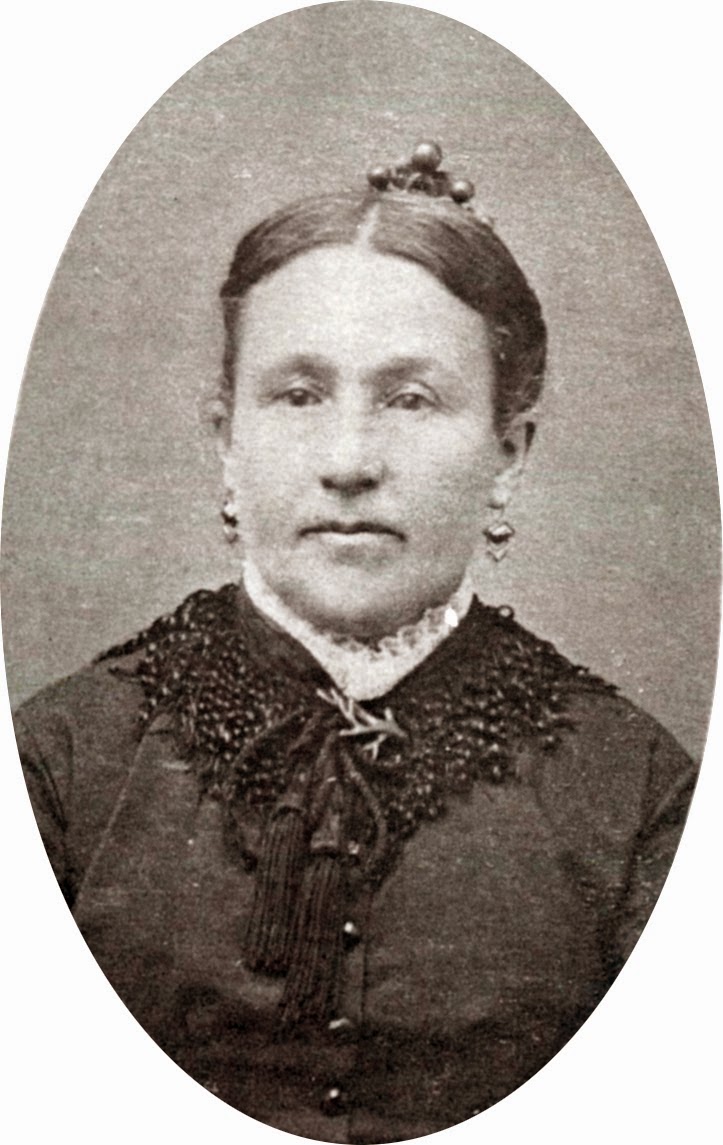
Henry Wells Jackson, about 1861.
Eliza Ann Dibble Jackson. International Society Daughters of Utah Pioneers.

Throughout his life, Henry was strongly motivated by his family’s financial well-being and traveled extensively. They first homesteaded in Tooele, and while his first child was being born, Henry was on the road to Iowa to claim 160 acres of bounty land for his Mormon Battalion service. He returned to Utah in early 1851.[7] The Tooele settlers lived on the western frontier and were easy prey for marauding Goshiute Indians, who often killed their cattle or stole their crops. “It is estimated that the Indians cost the Tooele settlers over five thousand dollars in stolen horses and cattle. . . . The Goshiutes regarded land, water, and food resources as belong to everyone, meaning no one owned them at all.”[8] For safety, the settlers moved their houses into a fort in 1851. 
Henry enlisted in the Utah territorial militia and often participated in campaigns to pursue these raiders.[9] In 1852, Henry traveled to San Francisco to make another land claim for his reenlistment in California.[10] Then, in 1853, he enlisted again in the Utah territorial militia.[11] 
Utah Territorial Militia, 1861. Church History Library.
After a three-year stay in San Bernardino, they were called back to Utah in 1857 during the Utah War. The Jacksons moved to Bountiful in late November to early December 1857. Later, the family relocated again, temporarily moving south to Springville, being prepared to torch the crops to deny the federal troops any forage.
Commanding General’s Quarters, Camp Floyd, Utah Territory, January 1859. Photograph by C. C. Mills, National Archives. 
Despite caustic rhetoric on both sides, most hostilities were mitigated, with the notable exception of the Mountain Meadows Massacre.[12] The army peacefully marched in and established Camp Floyd, the country’s largest outpost of troops. Ironically, the unwelcome presence of federal troops infused much-needed cash and job opportunities into the local economy.[13] For example, early in 1858 George W. Chorpenning Jr. resecured a contract to deliver “mail every two weeks between Salt Lake City and Placerville, California, for about $34,000 a year. By the time service started that July, the route had been improved to weekly, and his pay nearly quadrupled.”[14] 
George W. Chorpenning Jr., western mail pioneer.
To prepare for this weekly service, Chorpenning ordered twenty Concord coaches, and “mules were stationed in teams at remount points twenty-five miles apart. . . . Chorpenning’s associates in the old Utah–Southern California contract, meanwhile, hustled their gear north and built a similar line of stations from Salt Lake City to Wells, Nevada.”[15] In the fall of 1858, Henry began working for Chorpenning. 
Major Howard Egan. Painting by William Egan Sylvester.
One of his coworkers was Major Howard Egan, who had created a shortcut trail through the desert.[16] Essentially, Egan’s shortcut “ran south out of Salt Lake through the Jordan Narrows into . . . Utah Valley, where it then turned west and ascended through Rush Valley at Five Mile Pass. This new route, used for both passenger and mail transport, shortened the traveling distance at least 250 miles. . . . There were 54 stations marked on the Egan trail from Salt Lake City to Placerville, covering a distance of approximately 650 miles.”[17]
Chorpenning's mail route in 18581860 is marked with a dotted line. John M. Townley, “Stalking Horse for the Pony Express: The Chorpenning Mail Contracts between California and Utah, 1851–1860,” Arizona and the West 24, no. 3 (Autumn 1982): 233.
Over the years, mail was delayed by Indian attacks and the snow-packed northern Utah valleys and Sierra Nevada. Congress heard about the mail delays and then delayed payment because of budget battles (some things never change!). In June 1858, Congress adjourned without appropriating money for the mail. Postmaster General Aaron Brown apologetically offered “letters of obligation” to use as security to get loans.[18] 
Postmaster General Aaron Brown, March 1857– March 1859.
To stay afloat, Chorpenning mortgaged several properties, and his coaches finally arrived in October 1858. “On November 21 he dispatched a column of fifty wagons and over 300 animals southwest from Temple Square along the new cutoff. Weekly coaches would thereafter be rerouted south from Granite Pass, bypassing the snow-clogged northern valleys.”[19] Then in December 1858, Chorpenning had a bright idea that others eventually coopted. He had men on horses deliver a presidential message from coast to coast in just seventeen days, proving that his central route was the quickest way to the West. He thus unwittingly gave William Russell the idea for a faster Pony Express, which displaced his service two years later using the very same roads and stations.
Pony Express rider flanked by American Indians.
In February 1859, Chorpenning was promised an additional $60,000 a year, but then the postmaster general died in March. The new postmaster general, Joseph Holt, was very budget conscious and cut the deliveries back to bimonthly, trimming the fee by $70,000. Congress again adjourned without paying for the mail—this was the final straw.
Postmaster General Joseph Holt, March 1859–December  1860.
On May 11, 1860, the postmaster general acted on complaints of mail delays and Chorpenning’s indebtedness. He nullified the mail contract with the claim of “bad management.”[20] That same day a contract was signed with the Pony Express, which had begun service a month earlier. Ironically, the Pony Express would be replaced eighteen months later by the transcontinental telegraph. Talk about disruptive technology!
Pony Express rider passing workers laying telegraph line.
Chorpenning’s financial woes left many workers unpaid, including Henry Jackson. In April 1861, just after Civil War broke out in the East, Henry finished gathering the papers necessary to file a claim for his back pay of $1,300. On May 8, 1861, he left his wife and three children in Springville. He traveled between various states, staying with his siblings and their families and working to pay his bills. In Washington, D.C., he contacted Chorpenning, who promised to pay him in four months. For the rest of his life, Chorpenning unsuccessfully attempted to collect his promised $430,000.[21]
In the fall of 1861, being low on cash, Henry began working as an assistant wagon master for thirty-five dollars a month. He hauled provisions and forage for federal military units located around the city.[22] His duties eventually expanded to areas outside the capital, and during one trip he was captured by Confederate forces. For about three months, he was held in a Southern prison camp and later exchanged for Confederate prisoners. Because of the way he was treated, he decided to fight for the Union, volunteering as a lieutenant in the First Regiment, District of Columbia Cavalry.[23] Unfortunately, he was soon transferred from his defensive position around the capital to an overland campaign in Virginia to control railways supplying Confederate troops. 
Typical cavalry skirmish in the Civil War.
Exactly three years to the day that he left home, he would be mortally wounded while taking a railroad bridge from Confederates, becoming Utah’s only Civil War battle fatality.

Notes

[1] Samuel Brannan, “Gold Discovery in California,” Calistoga Tribune, April 11, 1872, 1, 37. For a discussion of Mormon Battalion involvement in the gold rush, see Kenneth N. Owens, “Far from Zion: The Frayed Ties between California’s Gold Rush Saints and LDS President Brigham Young,” California History 89, no. 4 (2012): 5–23.
[2] Kenneth N. Owens, Gold Rush Saints: California Mormons and the Great Rush for Riches (Norman: University of Oklahoma Press, 2004), 369.
[3] Henry Jackson’s deposits to the Utah gold accounts are listed by amount in J. Kenneth Davies and Lorin K. Hansen, Mormon Gold: Mormons in the California Gold Rush, 2nd ed. (North Salt Lake City: Granite Mountain, 2010), 83–84, 153. For the minting of Mormon currency, see chapter 7.
[4] Davies and Hansen, Mormon Gold, 87.
[5] Eliza Ann Dibble was born on August 16, 1829, in Claymore, Cayuga County, Ohio, to Philo Dibble (1806–95) and Celia Kent (1803–40). Eliza was briefly married to Orson Spencer, though Brigham Young later canceled the marriage.
[6] The Youngs and the Jacksons were indeed well acquainted. Brigham Young performed their wedding, and Henry Jackson paid fifty dollars in California gold dust to Brigham’s wife Mima for providing the wedding party. The Story of Eliza Ann Dibble and Her Three Husbands, Orson Spencer, Henry W. Jackson, and Julius A. C. Austin (n.p., 1995), 49, 60.
[7] Smith, “Hidden Personalities among Mormon Battalion Members.”
[8] Tooele County Daughters of Utah Pioneers, History of Utah’s Tooele County: From the Edge of the Great Basin Frontier (Tooele, UT: Transcript Bulletin, 2012), 262, 17.
[9] Archival records show him as a private in James Ferguson’s Company from April 23 to May 1 and in W. McBride’s Company from June 14 to 27, 1851. Territorial Militia Service Cards, Utah State Archives and Records Service, Series 6195, reel 1. I appreciate the research assistance of Tony Castro and Doug Misner at the Utah State Archives.
[10] Smith, “Hidden Personalities among Mormon Battalion Members.”
[11]He appears on militia records as a private in W. H. Kimball’s Company from August 25 to September 10 and in J. W. Cumming’s Company from September 6 to October 9, 1853 (the last two periods overlap a few days).
[12] For a history of the Utah War and Kane’s intervention between the Saints and the federal army, see Matthew J. Grow, “Liberty to the Downtrodden”: Thomas L. Kane, Romantic Reformer (New Haven, CT: Yale, 2009), chaps. 9–10.
[13] Durwood Ball, Army Regulars on the Western Frontier, 1848–1861 (Norman, OK: University of Oklahoma Press, 2001), 166.
[14] Smith, The Story of Eliza Ann Dibble and Her Three Husbands, 61.
[15] John M. Townley, “Stalking Horse for the Pony Express: The Chorpenning Mail Contracts between California and Utah, 1851–1860,” Arizona and the West 24, no. 3 (Autumn 1982): 240.
[17] Massey, “Synopsis of Major Howard Egan,” http://www.xphomestation.com/ks-massey.pdf.
[18] Townley, “Stalking Horse for the Pony Express,” 246–47.
[19] Townley, “Stalking Horse for the Pony Express,” 245.
[20] Townley, “Stalking Horse for the Pony Express,” 248–52.
[21] Obituary for George W. Chorpenning, Somerset Herald, April 11, 1894.
[22] Henry Wells Jackson to John and Rachel Wright, October 27, 1861, transcript of letter in author’s possession.
[23] Smith, The Story of Eliza Ann Dibble and Her Three Husbands, 63.

Monday, May 26, 2014

Henry Wells Jackson, Mormon Battalion and Civil War Veteran

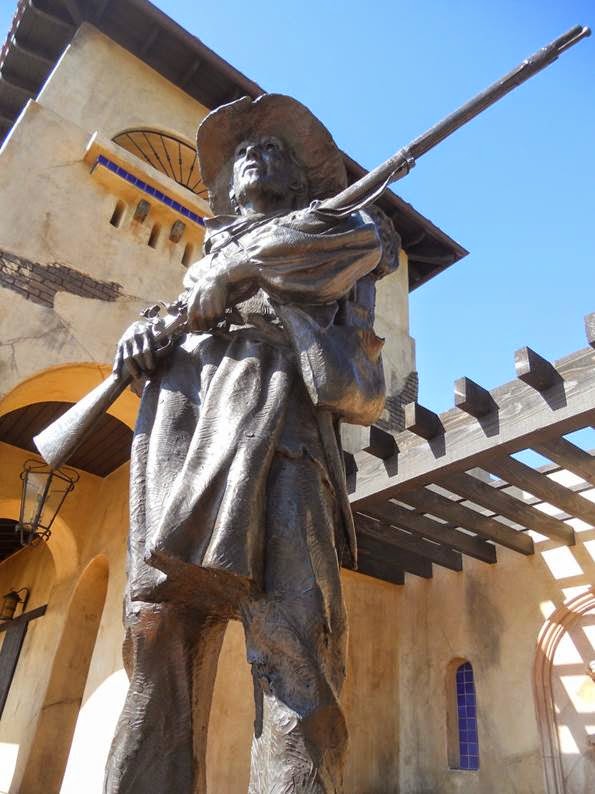
Statue at San Diego Mormon Battalion Historic Site
Henry Wells Jackson was a wandering Mormon hero who was motivated by duty to God, country, and family. His life was marked by many significant firsts.[1] He was among the first to march west to California in the Mormon Battalion, the first U.S. military unit based on religious affiliation. He was among the first to pan for gold only weeks after its discovery at Sutter’s sawmill. He served in Utah’s early territorial militia and mail service between Utah and California. Years later, he was commissioned a Union lieutenant in the Civil War and was shot by Confederates while leading an assault on a railroad bridge, becoming the first Latter-day Saint known to be killed in an American national war. He was the Civil War’s first and only battle fatality from Utah.[2] This essay will focus on his service in the Mormon Battalion and then reenlistment in the Mormon Volunteers. An expanded version will be delivered at the Mormon History Association's annual meeting in San Antonio, Texas, on June 6, 2014. This year marks 150 years since Lt. Jackson's death.

Captain James Allen

Mormon Battalion Service


On July 1, 1846, at Council Bluffs, Iowa, Captain James Allen of the U.S. Army met with Brigham Young to recruit five hundred Mormon men to march west to California in support of the war against Mexico.[3] Some twelve thousand Latter-day Saints were scattered across Iowa, and initially many of the potential recruits fiercely opposed serving a federal government that had forsaken them. They had been expelled first from Missouri and then Illinois.

John Steele recorded his strong opposition to fighting for the United States: “I will see them in hell before I will fire one shot against a foreigner for . . . those who have mobbed, robbed, plundered and destroyed us all the day long and now seek to enslave us to fight for them.”[4]
  
President Young, however, saw providence in this offer. Months earlier he had sent his nephew Jesse C. Little to the nation’s capital to seek financial opportunities for emigration, charging him, “as a wise and faithful man, [to] take every honorable advantage of the times you can.”[5] At the encouragement of non-Mormon advocate Thomas L. Kane,[6] Little wrote to President James K. Polk on June 1, explaining the Saints’ intent to go west and hinting that they wanted to remain loyal to the United States but might look for help from foreign governments. President Polk wanted to maintain the balance of power in California and authorized Colonel Stephen W. Kearny to form a battalion to march to California.[7]

President Young urged the men to enlist and donate their funds to help the Saints move west. One recruit, Daniel B. Rawson, recorded his change of heart: “I felt indignant toward the Government that had suffered me to be raided and driven from my home. . . . I would not enlist. [Then] we met President Brigham Young, Heber C. Kimball and [Willard] Richards . . . calling for recruits. They said the salvation of Israel depended upon the raising of the army. When I heard this my mind changed. I felt that it was my duty to go.”[8] Nineteen-year-old convert Henry Wells Jackson also heeded the call to serve and consecrated his earnings. He enlisted as a fife player in Company D along with Rawson and the newly softened Steele.[9]
 
Henry likely viewed this military service as a grand adventure.That sense of adventure must have worn thin, however, as the footsore battalion marched some nineteen hundred miles through the deserts of the Southwest—from Council Bluffs to Fort Leavenworth, Kansas Territory; to Santa Fe, New Mexico. The journey was arduous. Three sick detachments traveled north to Pueblo, Colorado. Meanwhile, often marching without enough food and water, the rest of the battalion created a wagon road from Santa Fe to the Pima Indian villages in Arizona.


Wagon road through Box Canyon, Anza-Borrego Desert State Park.

Courtesy of Mike Stangeman.


Final Approach to San Diego

Sgt. Daniel Tyler recorded the difficult final approach to the San Diego area in the Anzo-Borrego region: “We here found the heaviest sand, hottest days and coldest nights, with no water and but little food. . . . At the time the men were nearly barefooted; some used, instead of shoes, rawhide wrapped around their feet, while others improvised a novel style of boots by stripping the skin from the leg of an ox. . . . Others wrapped cast-off clothing around their feet.”[10] 


On January 19, 1847, Box Canyon had to be widened so the wagons could pass. Tyler recorded: As we traveled up the dry bed, the chasm became more contracted until we found ourselves in a passage at least a foot narrower than our wagons. Nearly all of our road tools, such as picks, shovels, spades, etc., had been lost in the boat disaster [at Yuma, Arizona]. The principal ones remaining were a few axes, . . . a small crow bar, and perhaps a spade or two. These were brought into requisition, the commander [Philip St. George Cooke] taking an ax and assisting the pioneers.”[11]
Philip St. George Cooke


On January 27, the battalion boys cheered when they saw the Pacific.[12] Their long march ended on January 29, and they camped about five miles north of San Diego. The day after arriving, Lt. Col. Philip St. George Cooke praised their endurance: “History may be searched in vain for an equal march of infantry. . . . With crowbar and pick and ax in hand we have worked our way over mountains which seemed to defy aught save the wild goat, and hewed a passage through a chasm of living rock more narrow than our wagons.”[13] His remarks were “cheered heartily.”[14] Through their hardships, they had formed a wagon road to the Pacific and helped define the southern boundary of the United States.[15]  


Flag Raising at Fort Moore, Los Angeles, July 4, 1847


Peacekeeping and Construction

For the next five months in southern California, they performed occupation duties. They served as a reliable unit to block John C. Frémont’s unauthorized bid to control California. They built Fort Moore in Los Angeles and managed to complete it in time to celebrate California's first Fourth of July celebration.[16] Toward the end of their service, the U.S. Army desperately sought their reenlistment to provide military stability. Chief among those recruiters was their latest commanding officer, Colonel Jonathan D. Stevenson, who delivered a flattering speech on June 22. Robert Bliss summarized the speech in his journal: “Gave us the praise of being the best company in the Southern Division of California; the most intelligent & correct Soldiers. Said we were universally esteemed & respected by the inhabitants & in Short we had done more for California than any other people.”[17] 

The Mormon Volunteers in San Diego

The battalion was mustered out in Los Angeles on July 16, 1847. Henry was among eighty-one Mormons who reenlisted as a company of Mormon Volunteers and served eight more months.[18] He had no family on the way to Utah, so he likely reenlisted to earn more money and continue providing military stability. Many of those who reenlisted were either unmarried or reenlisted for financial reasons. The Mormon Volunteers reenlisted only on condition that they be discharged by March 1848, allowing time to plant crops in the Salt Lake Valley, and that they be furnished with pay and rations for their trek.[19]
 
Replica uniform of Seventh New York Regiment of Volunteers. Courtesy of Paul A. Hoffman.

Most of this ragged little company, including Henry, began serving in San Diego, where they were newly attired in uniforms belonging to the Seventh New York Regiment of Volunteers.[20] With Captain Daniel C. Davis in command, one of their first duties was to remodel the leaky pueblo barracks. They also helped keep the peace and constructed a brick courthouse. Col. Richard B. Mason, acting military governor of California, offered high praise: “Of their services . . . , of their patience, subordination, and general good conduct, you have already heard, and I take great pleasure in adding, that, as a body of men, they have religiously respected the rights and feelings of these conquered people, and not a syllable of complaint has reached my ears of a single insult offered, or outrage done, by a Mormon volunteer.”[21] Although a few of the men were dishonest, the battalion's overall service was exemplary.

Reconstructed Sutter's sawmill and millrace

During this period of service, several battalion boys traveled northward to work for John Sutter, digging the millrace where gold was discovered on January 24, 1848. Less than two months later, on March 14, the Mormon Volunteers disbanded, and Henry joined the battalion boys at nearby Mormon Island (now under Folsom Lake), where he panned for gold for about a year. He and many other battalion members made substantial deposits in the Utah gold account, an important resource to back the early Utah currency.[22] Historian Kenneth N. Owens concludes that “without the 1848 gold discovery and the rush for riches that followed, the development of the LDS church and community in the Great Basin must certainly have taken an alternative course. The difficult economic challenges the Saints faced in their valley in the mountains would have intensified.”[23] 

Early Mormon currency


As Brigham Young predicted two years earlier, the Mormon Battalion became “the salvation of Israel.” They consecrated money that helped the emigrating Saints. They created important roads that paved the way for future settlement of the Southwest. They helped stabilize California. They deposited gold that shored up Utah's fledgling economy. And they become confident frontiersman who helped colonize the western United States.

Notes

[1] Henry Wells Jackson was born in Chemung, Chemung County, New York, on March 10, 1827, to William Jackson (1787–1869) and Mary Troy (1795–1838). Henry and his brother James joined The Church of Jesus Christ of Latter-day Saints in New York and moved to Nauvoo, Illinois.
[2] Henry Wells Jackson’s life story is briefly summarized in Robert C. Freeman, “Latter-day Saints in the Civil War,” in Civil War Saints, ed. Kenneth L. Alford (Provo, UT: Religious Studies Center; Salt Lake City: Deseret Book, 2012), 280–81.
[3] The causes of the war and the Mormon Battalion’s involvement are detailed in Sherman L. Fleek, History May Be Searched in Vain: A Military History of the Mormon Battalion (Spokane, WA: Arthur H. Clark, 2006).
[4] John Steele, “Extracts from the Journal of John Steele,” Utah Historical Quarterly 6, no. 1 (1933): 6–7, in Fleek, History May Be Searched in Vain, 54.
[5] Jesse C. Little’s report as cited in B. H. Roberts, A Comprehensive History of the Church of Jesus Christ of Latter-day Saints (Salt Lake City: Deseret News Press, 1930), 3:67.
[6] On May 13, 1846, Kane attended a Mormon conference in Philadelphia where Jesse C. Little was speaking. Thus began Kane’s lifelong advocacy for the Mormons’ cause. See Matthew J. Grow, “Liberty to the Downtrodden”: Thomas L. Kane, Romantic Reformer (New Haven, CT: Yale, 2009), 47–56.
[7] See David L. Bigler and Will Bagley, eds., Army of Israel: Mormon Battalion Narratives (Logan: Utah State University Press, 2000), 31–37.
[8] Daniel B. Rawson, as cited in Norma Baldwin Ricketts, The Mormon Battalion: U.S. Army of the West, 1846–1848 (Logan: Utah State University Press, 1996), 13.
[9] This telling of Henry Jackson’s life story relies heavily on two family histories: The Story of Eliza Ann Dibble and Her Three Husbands, Orson Spencer, Henry W. Jackson, and Julius A. C. Austin, comp. Marilyn Austin Smith (n.p., 1995) and “Hidden Personalities among Mormon Battalion Members,” by Don Smith; https://familysearch.org/photos/stories/1079244/daniel-browett-hidden-personalities-among-mormon-battalion.
[10] Daniel Tyler, A Concise History of the Mormon Battalion in the Mexican War, 1846–1847 (Salt Lake City: n.p., 1881), 244–45.
[11] Tyler, Concise History, 248. This wagon road became part of the Butterfield Overland Mail Route.
[12] Tyler, Concise History, 252.
[13] Lt. Col. Philip St. George Cooke, Order No. 1, quoted in Bigler and Bagley, Army of Israel, 17.
[14] Tyler, Concise History, 255.
[15] See Michael N. Landon and Brandon J. Metcalf, History of the Saints: The Remarkable Journey of the Mormon Battalion (American Fork, UT: Covenant Communications, 2012), 7.
[16] For more detail, see Fleek, History May Be Searched in Vain, 321–23.
[17] Robert S. Bliss, “The Journal of Robert S. Bliss, with the Mormon Battalion,” Utah Historical Quarterly 4 (July/October 1931): 96.
[18] Although Col. Stevenson, 7th New York Regiment of Volunteers, was glad when some of the battalion members agreed to reenlist, he privately confided to Col. Mason, military governor of California, worries that they might try to take over southern California to aid their Utah settlement. See confidential letter, Col. J. D. Stevenson to Governor Mason, July 23, 1847, Records of the 10th Military Department, 1846–1851, National Archives Microfilm Publication, microcopy 210, roll 2.
[19] John F. Yurtinus, “The Mormon Volunteers: The Recruitment and Service of a Unique Military Company,” Journal of San Diego History 25, no. 3 (Summer 1979): 242–61.
[20] Col. J. D. Stevenson, 7th New York Regiment of Volunteers, wrote to Col. R. B. Mason, July 23, 1847, stating that the reenlisted members of the Mormon Battalion were dressed “from cap to shoe, in the uniform of my Regiment.” In Charles Hughes, ed., “A Military View of San Diego in 1847: Four Letters from Colonel Jonathan D. Stevenson to Governor Richard B. Mason,” Journal of San Diego History 20, no. 3 (September 1974): 33–43.
[21] Richard B. Mason to General R. Jones, Sen. Exec. Doc. 18 (31-1), Serial 557, 318–22, in Bigler and Bagley, Army of Israel, 394–95.
[22] Henry Jackson’s deposits to the Utah gold accounts are listed by amount in J. Kenneth Davies and Lorin K. Hansen, Mormon Gold: Mormons in the California Gold Rush, 2nd ed. (North Salt Lake City: Granite Mountain, 2010), 83–84, 153. For a discussion of Mormon Battalion involvement in the gold rush, see Kenneth Owens, “Far from Zion: The Frayed Ties between California’s Gold Rush Saints and LDS President Brigham Young,” California History 89, no. 4 (2012): 5–23.
[23] Kenneth N. Owens, Gold Rush Saints: California Mormons and the Great Rush for Riches (Norman: University of Oklahoma Press, 2004), 369.

Battlefields to Temple Grounds: Latter-day Saints in Guam and Micronesia

Devan Jensen and Rosalind Meno Ram, editors of Battlefields to Temple Grounds: Latter-day Saints in Guam and Micronesia , thank our readers...