Showing posts with label Brigham Young. Show all posts
Showing posts with label Brigham Young. Show all posts
Wednesday, February 12, 2020
Review of Saints, Vol. 2: No Unhallowed Hand, 1846–1893

Review of Saints: The Story of the Church of Jesus Christ in the Latter Days. Volume 2, No Unhallowed Hand, 1846–1893

Monday, July 28, 2014
The Utah War and Mountain Meadows Massacre
The Utah War and Mountain Meadows Massacre together
form one of the darkest chapters in the history of The Church of Jesus Christ
of Latter-day Saints (Mormons). To help readers understand these events, this
blog post gathers historical perspectives from historians both outside and
inside the faith. Like a tapestry woven of many threads, the various accounts show us the complex issues and individuals involved in the Utah War.
A
Non-Mormon Perspective on the Utah War
“So what was the Utah War?” asks William P.
MacKinnon, an independent historian who happens to be Presbyterian. He then answers
his own question: “In one sense it was President James Buchanan’s effort to
replace Brigham Young as governor of Utah Territory and to install his
successor with an army escort of 2,500 troops, a change that Young resisted
with guerrilla tactics until a settlement was reached a year later in 1858.
Over the years I have come to define it more formally as the armed confrontation
over power and authority during 1857–58 between the civil-religious leadership of
Utah Territory, led by Governor Brigham Young, and the administration of
President James Buchanan—a conflict that pitted perhaps the nation’s largest,
most experienced territorial militia (called the Nauvoo Legion) against an
expeditionary force that ultimately grew to involve almost one-third of the
U.S. Army.[i]
 |
| President James Buchanan |
MacKinnon
says that while teaching or writing about the Utah War, we would be wise to
avoid inaccurate or belittling nicknames for elements of this conflict such as “Johnston’s
Army” or “Buchanan’s Blunder.” These terms oversimplify the nature of the events and complex issues at stake.[ii]
Human nature being what it is, mistakes were made by both President Buchanan and Governor Young: “In Buchanan’s case, he knew shockingly little in 1857 about either conditions in Utah or Brigham Young’s likely reaction to his removal as governor. Compounding this serious shortfall in intelligence was a series of horrible selection decisions—the appointment of a homicidal, ham-handed brevet brigadier general, William S. Harney, as the Utah Expedition’s initial commander and Alfred Cumming, an inexperienced four-hundred-pound alcoholic, as Young’s successor. These were appointments that bring to mind the old lesson about nothing being as expensive as bad management.”[iii] Another huge mistake was unwillingness to communicate with Governor Young before or after sending a hostile force.
Human nature being what it is, mistakes were made by both President Buchanan and Governor Young: “In Buchanan’s case, he knew shockingly little in 1857 about either conditions in Utah or Brigham Young’s likely reaction to his removal as governor. Compounding this serious shortfall in intelligence was a series of horrible selection decisions—the appointment of a homicidal, ham-handed brevet brigadier general, William S. Harney, as the Utah Expedition’s initial commander and Alfred Cumming, an inexperienced four-hundred-pound alcoholic, as Young’s successor. These were appointments that bring to mind the old lesson about nothing being as expensive as bad management.”[iii] Another huge mistake was unwillingness to communicate with Governor Young before or after sending a hostile force.
 |
| Governor Brigham Young |
If there is a bright spot in the story of the Utah War, it is Colonel Thomas L. Kane's heroic effort to travel west and mediate peace between the disgruntled parties. Matthew Grow has written a fine biography of Kane's life and leadership titled "Liberty to the Downtrodden": Thomas L. Kane, Romantic Reformer. Kane has become one of my heroes.
Historical Perspective on the Utah War
In 2014, the Church website LDS.org posted an
official statement on the historical context of the Utah War:
The “Reformation” and
the Utah War
In the mid-1850s, a “reformation” within the Church
and tensions between the Latter-day Saints in Utah and the U.S. federal
government contributed to a siege mentality and a renewed sense of persecution
that led to several episodes of violence committed by Church members. Concerned
about spiritual complacency, Brigham Young and other Church leaders delivered a
series of sermons in which they called the Saints to repent and renew their
spiritual commitments. Many
testified that they became better people because of this reformation.
Nineteenth-century Americans were accustomed to
violent language, both religious and otherwise. Throughout the century,
revivalists had used violent imagery to encourage the unconverted to repent and
to urge backsliders to reform. At
times during the reformation, President Young, his counselor Jedediah M. Grant,
and other leaders preached with fiery rhetoric, warning against the evils of
those who dissented from or opposed the Church. Drawing on biblical passages,
particularly from the Old Testament, leaders taught that some sins were so
serious that the perpetrator’s blood would have to be shed in order to receive
forgiveness. Such preaching led
to increased strain between the Latter-day Saints and the relatively few
non-Mormons in Utah, including federally appointed officials.
In early 1857, U.S. President James Buchanan received
reports from some of the federal officials alleging that Governor Young and the
Latter-day Saints in Utah were rebelling against the authority of the federal
government. A strongly worded memorial from the Utah legislature to the federal
government convinced federal officials the reports were true. President
Buchanan decided to replace Brigham Young as governor and, in what became known
as the Utah War, sent an army to Utah to escort his replacement. Latter-day
Saints feared that the oncoming army—some 1,500 troops, with more to
follow—would renew the depredations of Missouri and Illinois and again drive
the Saints from their homes. In addition, Parley P. Pratt, a member of the
Quorum of the Twelve Apostles, was murdered in Arkansas in May 1857. News of
the murder—as well as newspaper reports from the eastern United States that
celebrated the crime—reached Utah in late June 1857. As these events unfolded, Brigham
Young declared martial law in the territory, directed missionaries and settlers
in outlying areas to return to Utah, and guided preparations to resist the
army. Defiant sermons given by President Young and other Church leaders,
combined with the impending arrival of an army, helped create an environment of
fear and suspicion in Utah.
The Mountain Meadows Massacre
At the peak of this tension, in early September 1857,
a branch of the territorial militia in southern Utah (composed entirely of
Mormons), along with some Indians they recruited, laid siege to a wagon train
of emigrants traveling from Arkansas to California. As the wagon train traveled
south from Salt Lake City, the emigrants had clashed verbally with local
Mormons over where they could graze their cattle. Some of the members of the
wagon train became frustrated because they had difficulty purchasing
much-needed grain and other supplies from local settlers, who had been
instructed to save their grain as a wartime policy. Aggrieved, some of the
emigrants threatened to join incoming troops in fighting against the Saints.
Although some Saints ignored these threats, other
local Church leaders and members in Cedar City, Utah, advocated violence. Isaac
C. Haight, a stake president and militia leader, sent John D. Lee, a militia
major, to lead an attack on the emigrant company. When the president reported
the plan to his council, other leaders objected and requested that he call off
the attack and instead send an express rider to Brigham Young in Salt Lake City
for guidance. But the men Haight had sent to attack the emigrants carried out
their plans before they received the order not to attack. The emigrants fought
back, and a siege ensued.
Over the next few days, events escalated, and Mormon
militiamen planned and carried out a deliberate massacre. They lured the
emigrants from their circled wagons with a false flag of truce and, aided by
Paiute Indians they had recruited, slaughtered them. Between the first attack
and the final slaughter, the massacre destroyed the lives of 120 men, women,
and children in a valley known as Mountain Meadows. Only small children—those
believed to be too young to be able to tell what had happened—were spared. The
express rider returned two days after the massacre. He carried a letter from
Brigham Young telling local leaders to “not meddle” with the emigrants and to
allow them to pass through southern Utah. The
militiamen sought to cover up the crime by placing the entire blame on local
Paiutes, some of whom were also members of the Church.
Two Latter-day Saints were eventually excommunicated
from the Church for their participation, and a grand jury that included
Latter-day Saints indicted nine men. Only one participant, John D. Lee, was
convicted and executed for the crime, which fueled false allegations that the
massacre had been ordered by Brigham Young.
In recent years, the Church has made diligent efforts
to learn everything possible about the massacre. In the early 2000s, historians
in the Church History Department of The Church of Jesus Christ of Latter-day
Saints scoured archives throughout the United States for historical records;
every Church record on the massacre was also opened to scrutiny. In the
resulting book, published by Oxford University Press in 2008, authors
Ronald W. Walker, Richard E. Turley Jr., and Glen M. Leonard concluded
that while intemperate preaching about outsiders by Brigham Young,
George A. Smith, and other leaders contributed to a climate of hostility,
President Young did not order the massacre. Rather, verbal confrontations
between individuals in the wagon train and southern Utah settlers created great
alarm, particularly within the context of the Utah War and other adversarial
events. A series of tragic decisions by local Church leaders—who also held key
civic and militia leadership roles in southern Utah—led to the massacre.
Aside from the Mountain Meadows Massacre, a few
Latter-day Saints committed other violent acts against a small number of
dissenters and outsiders. Some Latter-day Saints perpetrated acts of extralegal
violence, especially in the 1850s, when fear and tensions were prevalent in
Utah Territory. The heated rhetoric of Church leaders directed toward
dissenters may have led these Mormons to believe that such actions were
justified. The perpetrators of
these crimes were generally not punished. Even so, many allegations of such
violence are unfounded, and anti-Mormon writers have blamed Church leaders for
many unsolved crimes or suspicious deaths in early Utah.
Conclusion
Many people in the 19th century unjustly
characterized the Latter-day Saints as a violent people. Yet the vast majority
of Latter-day Saints, in the 19th century as today, lived in peace with their
neighbors and families, and sought peace in their communities. Travelers in the
19th century often noted the peace and order that prevailed in Mormon
communities in Utah and elsewhere. Nevertheless,
the actions of relatively few Latter-day Saints caused death and injury, frayed
community relationships, and damaged the perception of Mormons as a peaceful
people.
The Church of Jesus Christ of Latter-day
Saints condemns violent words and actions and affirms its commitment to
furthering peace throughout the world. Speaking of the Mountain Meadows
Massacre, Elder Henry B. Eyring, then a member of the Quorum of the Twelve
Apostles, stated, “The gospel of Jesus Christ that we espouse abhors the
cold-blooded killing of men, women, and children. Indeed, it advocates peace
and forgiveness. What was done here long ago by members of our Church represents
a terrible and inexcusable departure from Christian teaching and conduct.”
Throughout the Church’s history, Church
leaders have taught that the way of Christian discipleship is a path of peace.
Elder Russell M. Nelson of the Quorum of the Twelve Apostles connected the
Latter-day Saints’ faith in Jesus Christ to their active pursuit of love of
neighbor and peace with all people: “The hope of the world is the Prince of
Peace. … Now, as members of The Church of Jesus Christ of Latter-day
Saints, what does the Lord expect of us? As a Church, we must ‘renounce war and
proclaim peace.’ As individuals, we should ‘follow after the things which make
for peace.’ We should be personal peacemakers.”[vii]
Details of the Mountain Meadows Massacre
Richard
E. Turley, Assistant Church Historian, provided details about the Mountain
Meadows Massacre in an Ensign article
(before publishing the landmark book Massacre at Mountain Meadows with Ronald Walker and Glen Leonard):
On September 11,
1857, some 50 to 60 local militiamen in southern Utah, aided by American Indian
allies, massacred about 120 emigrants who were traveling by wagon to
California. The horrific crime, which spared only 17 children age six and
under, occurred in a highland valley called the Mountain Meadows, roughly 35
miles southwest of Cedar City. The victims, most of them from Arkansas, were on
their way to California with dreams of a bright future.
For a century
and a half the Mountain Meadows Massacre has shocked and distressed those who
have learned of it. The tragedy has deeply grieved the victims’ relatives,
burdened the perpetrators’ descendants and Church members generally with sorrow
and feelings of collective guilt, unleashed criticism on the Church, and raised
painful, difficult questions. How could this have happened? How could members
of the Church have participated in such a crime?
Two facts make
the case even more difficult to fathom. First, nothing that any of the
emigrants purportedly did or said, even if all of it were true, came close to
justifying their deaths. Second, the large majority of perpetrators led decent,
nonviolent lives before and after the massacre.
As is true with
any historical episode, comprehending the events of September 11, 1857,
requires understanding the conditions of the time, only a brief summary of
which can be shared in the few pages of this magazine article. For a more
complete, documented account of the event, readers are referred to the
forthcoming book Massacre at Mountain Meadows.
Historical
Background
In 1857 an army
of roughly 1,500 United States troops was marching toward Utah Territory, with
more expected to follow. Over the preceding years, disagreements,
miscommunication, prejudices, and political wrangling on both sides had created
a growing divide between the territory and the federal government. In
retrospect it is easy to see that both groups overreacted—the government sent
an army to put down perceived treason in Utah, and the Saints believed the army
was coming to oppress, drive, or even destroy them.
In 1858 this
conflict—later called the Utah War—was resolved through a peace conference and
negotiation. Because Utah’s militiamen and the U.S. troops never engaged each
other in pitched battle, the Utah War has been characterized as “bloodless.” But
the atrocity at Mountain Meadows made it far from bloodless.
As the troops
were making their way west in the summer of 1857, so were thousands of overland
emigrants. Some of these emigrants were Latter-day Saint converts en route to
Utah, but most westbound emigrants were headed for California, many with large
herds of cattle. The emigration season brought many wagon companies to Utah
just as Latter-day Saints were preparing for what they believed would be a
hostile military invasion. The Saints had been violently driven from Missouri
and Illinois in the prior two decades, and they feared history might repeat
itself.
Church President
and territorial governor Brigham Young and his advisers formed policies based
on that perception. They instructed the people to save their grain and prepare
to cache it in the mountains in case they needed to flee there when the troops
arrived. Not a kernel of grain was to be wasted or sold to merchants or passing
emigrants. The people were also to save their ammunition and get their firearms
in working order, and the territory’s militiamen were put on alert to defend
the territory against the approaching troops if necessary.
These orders and
instructions were shared with leaders throughout the territory. Elder George A.
Smith of the Quorum of the Twelve Apostles carried them to southern Utah. He,
Brigham Young, and other leaders preached with fiery rhetoric against the enemy
they perceived in the approaching army and sought the alliance of Indians in
resisting the troops.
These wartime
policies exacerbated tensions and conflict between California-bound emigrants
and Latter-day Saint settlers as wagon trains passed through Utah’s
settlements. Emigrants became frustrated when they were unable to resupply in
the territory as they had expected to do. They had a difficult time purchasing
grain and ammunition, and their herds, some of which included hundreds of
cattle, had to compete with local settlers’ cattle for limited feed and water
along the trail.
Some traditional
Utah histories of what occurred at Mountain Meadows have accepted the claim
that poisoning also contributed to conflict—that the Arkansas emigrants
deliberately poisoned a spring and an ox carcass near the central Utah town of
Fillmore, causing illness and death among local Indians. According to this
story, the Indians became enraged and followed the emigrants to the Mountain
Meadows, where they either committed the atrocities on their own or forced
fearful Latter-day Saint settlers to join them in the attack. Historical
research shows that these stories are not accurate.
While it is true
that some of the emigrants’ cattle were dying along the trail, including near
Fillmore, the deaths appear to be the result of a disease that affected cattle
herds on the 1850s overland trails. Humans contracted the disease from infected
animals through cuts or sores or through eating the contaminated meat. Without
this modern understanding, people suspected the problem was caused by
poisoning.
Escalating
Tensions
The plan to
attack the emigrant company originated with local Church leaders in Cedar City,
who had recently been alerted that U.S. troops might enter at any time through
southern Utah’s passes. Cedar City was the last place on the route to
California for grinding grain and buying supplies, but here again the emigrants
were stymied. Badly needed goods weren’t available in the town store, and the
miller charged a whole cow—an exorbitant price—to grind a few dozen bushels of
grain. Weeks of frustration boiled over, and in the rising tension one emigrant
man reportedly claimed he had a gun that killed Joseph Smith. Others threatened
to join the incoming federal troops against the Saints. Alexander Fancher,
captain of the emigrant train, rebuked these men on the spot.
The men’s
statements were most likely idle threats made in the heat of the moment, but in
the charged environment of 1857, Cedar City’s leaders took the men at their
word. The town marshal tried to arrest some of the emigrants on charges of
public intoxication and blasphemy but was forced to back down. The wagon
company made its way out of town after only about an hour, but the agitated
Cedar City leaders were not willing to let the matter go. Instead they planned
to call out the local militia to pursue and arrest the offending men and
probably fine them some cattle. Beef and grain were foods the Saints planned to
survive on if they had to flee into the mountains when the troops arrived.
Cedar City
mayor, militia major, and stake president Isaac Haight described the grievances
against the emigrant men and requested permission to call out the militia in an
express dispatch to the district militia commander, William Dame, who lived in
nearby Parowan. Dame was also the stake president of Parowan. After convening a
council to discuss the matter, Dame denied the request. “Do not notice their
threats,” his dispatch back to Cedar City said. “Words are but wind—they injure
no one; but if they (the emigrants) commit acts of violence against citizens
inform me by express, and such measures will be adopted as will insure
tranquility.”
Still intent on
chastening the emigrants, Cedar City leaders then formulated a new plan. If
they could not use the militia to arrest the offenders, they would persuade
local Paiute Indians to give the Arkansas company “a brush,” killing some or
all of the men and stealing their cattle.
They planned the
attack for a portion of the California trail that ran through a narrow stretch
of the Santa Clara River canyon several miles south of the Mountain Meadows.
These areas fell under the jurisdiction of Fort Harmony militia major John D.
Lee, who was pulled into the planning. Lee was also a federally funded “Indian
farmer” to local Paiutes. Lee and Haight had a long, late-night discussion
about the emigrants in which Lee told Haight he believed the Paiutes would
“kill all the party, women and children, as well as the men” if incited to
attack. Haight
agreed, and the two planned to lay blame for the killing at the feet of the
Indians.
The generally
peaceful Paiutes were reluctant when first told of the plan. Although Paiutes
occasionally picked off emigrants’ stock for food, they did not have a
tradition of large-scale attacks. But Cedar City’s leaders promised them
plunder and convinced them that the emigrants were aligned with “enemy” troops
who would kill Indians along with Mormon settlers.
On Sunday,
September 6, Haight presented the plan to a council of local leaders who held
Church, civic, and military positions. The plan was met with stunned resistance
by those hearing it for the first time, sparking heated debate. Finally,
council members asked Haight if he had consulted with President Young about the
matter. Saying he hadn’t, Haight agreed to send an express rider to Salt Lake
City with a letter explaining the situation and asking what should be done.
A Five-Day Siege
But the next
day, shortly before Haight sent the letter to Brigham Young, Lee and the
Indians made a premature attack on the emigrant camp at the Mountain Meadows,
rather than at the planned location in the Santa Clara canyon. Several of the
emigrants were killed, but the remainder fought off their attackers, forcing a
retreat. The emigrants quickly pulled their wagons into a tight circle, holing
up inside the defensive corral. Two other attacks followed over the next two
days of a five-day siege.
After the
initial attack, two Cedar City militiamen, thinking it necessary to contain the
volatile situation, fired on two emigrant horsemen discovered a few miles
outside the corral. They killed one of the riders, but the other escaped to the
emigrant camp, bringing with him the news that his companion’s killers were
white men, not Indians.
The conspirators
were now caught in their web of deception. Their attack on the emigrants had
faltered. Their military commander would soon know they had blatantly disobeyed
his orders. A less-than-forthcoming dispatch to Brigham Young was on its way to
Salt Lake City. A witness of white involvement had now shared the news within
the emigrant corral. If the surviving emigrants were freed and continued on to
California, word would quickly spread that Mormons had been involved in the
attack. An army was already approaching the territory, and if news of their
role in the attack got out, the conspirators believed, it would result in
retaliatory military action that would threaten their lives and the lives of
their people. In addition, other California-bound emigrant trains were expected
to arrive at Cedar City and then the Mountain Meadows any day.
Ignoring the
Council’s Decision
On September 9
Haight traveled to Parowan with Elias Morris, who was one of Haight’s two
militia captains as well as his counselor in the stake presidency. Again they
sought Dame’s permission to call out the militia, and again Dame held a Parowan
council, which decided that men should be sent to help the beleaguered
emigrants continue on their way in peace. Haight later lamented, “I would give
a world if I had it, if we had abided by the deci[s]ion of the council.”
Instead, when
the meeting ended, Haight and his counselor got Dame alone, sharing with him
information they had not shared with the council: the corralled emigrants
probably knew that white men had been involved in the initial attacks. They
also told Dame that most of the emigrants had already been killed in these
attacks. This information caused Dame, now isolated from the tempering
consensus of his council, to rethink his earlier decision. Tragically, he gave
in, and when the conversation ended, Haight left feeling he had permission to
use the militia.
On arriving at
Cedar City, Haight immediately called out some two dozen militiamen, most of
them officers, to join others already waiting near the emigrant corral at the
Mountain Meadows. Those who had deplored vigilante violence against their own
people in Missouri and Illinois were now about to follow virtually the same
pattern of violence against others, but on a deadlier scale
The Massacre
On Friday,
September 11, Lee entered the emigrant wagon fort under a white flag and
somehow convinced the besieged emigrants to accept desperate terms. He said the
militia would safely escort them past the Indians and back to Cedar City, but
they must leave their possessions behind and give up their weapons, signaling
their peaceful intentions to the Indians. The suspicious emigrants debated what
to do but in the end accepted the terms, seeing no better alternative. They had
been pinned down for days with little water, the wounded in their midst were
dying, and they did not have enough ammunition to fend off even one more
attack.
As directed, the
youngest children and wounded left the wagon corral first, driven in two
wagons, followed by women and children on foot. The men and older boys filed
out last, each escorted by an armed militiaman. The procession marched for a
mile or so until, at a prearranged signal, each militiaman turned and shot the
emigrant next to him, while Indians rushed from their hiding place to attack
the terrified women and children. Militiamen with the two front-running wagons
murdered the wounded. Despite plans to pin the massacre on the Paiutes—and
persistent subsequent efforts to do so—Nephi Johnson later maintained that his
fellow militiamen did most of the killing.
Communication—Too
Late
President
Young’s express message of reply to Haight, dated September 10, arrived in
Cedar City two days after the massacre. His letter reported recent news that no
U.S. troops would be able to reach the territory before winter. “So you see
that the Lord has answered our prayers and again averted the blow designed for
our heads,” he wrote.
“In regard to
emigration trains passing through our settlements,” Young continued, “we must
not interfere with them untill they are first notified to keep away. You must
not meddle with them. The Indians we expect will do as they please but you
should try and preserve good feelings with them. There are no other trains
going south that I know of[.] [I]f those who are there will leave let them go
in peace. While we should be on the alert, on hand and always ready we should
also possess ourselves in patience, preserving ourselves and property ever
remembering that God rules.”
When Haight read
Young’s words, he sobbed like a child and could manage only the words, “Too
late, too late.”
Aftermath
The 17 spared
children, considered “too young to tell tales,” were adopted by local families. Government
officials retrieved the children in 1859 and returned them to family members in
Arkansas. The massacre snuffed out some 120 lives and immeasurably affected the
lives of the surviving children and other relatives of the victims. A century
and a half later, the massacre remains a deeply painful subject for their
descendants and other relatives.
Although Brigham
Young and other Church leaders in Salt Lake City learned of the massacre soon
after it happened, their understanding of the extent of the settlers’
involvement and the terrible details of the crime came incrementally over time.
In 1859 they released from their callings stake president Isaac Haight and
other prominent Church leaders in Cedar City who had a role in the massacre. In
1870 they excommunicated Isaac Haight and John D. Lee from the Church.
In 1874 a
territorial grand jury indicted nine men for their role in the massacre. Most
of them were eventually arrested, though only Lee was tried, convicted, and
executed for the crime. Another indicted man turned state’s evidence, and
others spent many years running from the law. Other militiamen who carried out
the massacre labored the rest of their lives under a horrible sense of guilt
and recurring nightmares of what they had done and seen.[viii]
Learning from the Lessons of History
"Therefore, what?" is the question we might ask. The clear answer is that if we fail to learn the lessons of history we are doomed to repeat it. Several important themes emerge from the story of the Utah War:
1. Speak peace, not hostility. With the hindsight of history, we see that righteous indignation for a cause or crusade can spark hostility or even violence toward fellow human beings. In a modern application of this idea, social media allows us to share our views, but we must remember to speak peaceably of our brothers and sisters, even if they are imperfect. Hostile words always produce victims, and there are always social consequences toward purveyors of gossip.
2. Remember there are at least two sides to every issue, and good decisions come from good information. In retrospect, it would have been wise for President Buchanan to hear Governor Young's side of things before sending a hostile force to replace him. Applying this to our lives, when we overhear one side of an argument, we would be wise to seek out and hear the other side, developing a more accurate and complete view of the situation. Only then are we prepared to take tentative steps toward peace.
3. Recall that people view things through the lenses of past experiences. Governor Young and other leaders had been cast out of Missouri and Illinois into the wilderness of Utah. They saw a silent army approaching them as a threat and took what they considered to be appropriate defensive measures. What this suggests today is that we do not always understand why other people react the way they do until we talk to them about why they feel as they do.
4. When strong emotions rule, counsel with wise friends and leaders and do not act rashly. Isaac Haight started out right by counseling with friends and trusted leaders, but then he disregarded counsel and chose a rash and vengeful action. He later regretted charging forward before listening to Governor Young's counsel. In settings where emotions run deep, we must take opportunities to counsel with wise friends and then act calmly, patiently, and without vengeance.
For other applications of these lessons, see the excellent home-study lesson shared by Seminaries and Institutes here.
"Therefore, what?" is the question we might ask. The clear answer is that if we fail to learn the lessons of history we are doomed to repeat it. Several important themes emerge from the story of the Utah War:
1. Speak peace, not hostility. With the hindsight of history, we see that righteous indignation for a cause or crusade can spark hostility or even violence toward fellow human beings. In a modern application of this idea, social media allows us to share our views, but we must remember to speak peaceably of our brothers and sisters, even if they are imperfect. Hostile words always produce victims, and there are always social consequences toward purveyors of gossip.
2. Remember there are at least two sides to every issue, and good decisions come from good information. In retrospect, it would have been wise for President Buchanan to hear Governor Young's side of things before sending a hostile force to replace him. Applying this to our lives, when we overhear one side of an argument, we would be wise to seek out and hear the other side, developing a more accurate and complete view of the situation. Only then are we prepared to take tentative steps toward peace.
3. Recall that people view things through the lenses of past experiences. Governor Young and other leaders had been cast out of Missouri and Illinois into the wilderness of Utah. They saw a silent army approaching them as a threat and took what they considered to be appropriate defensive measures. What this suggests today is that we do not always understand why other people react the way they do until we talk to them about why they feel as they do.
4. When strong emotions rule, counsel with wise friends and leaders and do not act rashly. Isaac Haight started out right by counseling with friends and trusted leaders, but then he disregarded counsel and chose a rash and vengeful action. He later regretted charging forward before listening to Governor Young's counsel. In settings where emotions run deep, we must take opportunities to counsel with wise friends and then act calmly, patiently, and without vengeance.
For other applications of these lessons, see the excellent home-study lesson shared by Seminaries and Institutes here.
Notes
[i]
William P. MacKinnon, “The Utah War and Its Mountain Meadows Massacre: Lessons
Learned, Surprises Encountered,” FARMS
Review 20, no. 2 (2008): 239–40, http://publications.maxwellinstitute.byu.edu/publications/review/20/2/S00010-5176a44954a5710MacKinnon.pdf.
[ii] MacKinnon, “Utah War,” 240–41,
244.
[iii] MacKinnon, “Utah War,” 245.
[iv] MacKinnon, “Utah War,” 246.
[v] MacKinnon, “Utah War,” 245–46.
[vi] MacKinnon, “Utah War,” 243.
[vii]
“Peace and Violence among 19th-Century Latter-day Saints,” https://www.lds.org/topics/peace-and-violence-among-19th-century-latter-day-saints?lang=eng.
[viii] Richard E. Turley Jr., “The
Mountain Meadows Massacre,” Ensign,
September 2007, https://www.lds.org/ensign/2007/09/the-mountain-meadows-massacre?lang=eng.
Monday, May 26, 2014
Henry Wells Jackson, Mormon Battalion and Civil War Veteran
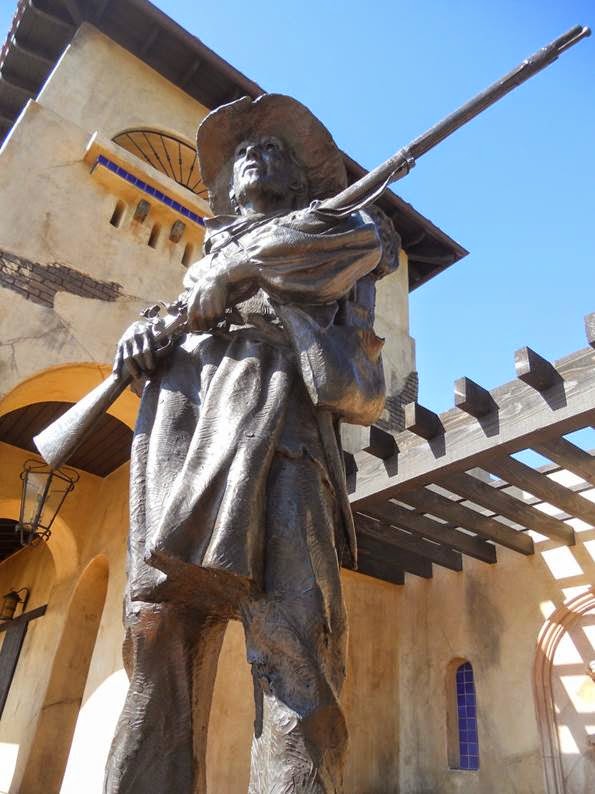 |
| Statue at San Diego Mormon Battalion Historic Site |
Henry Wells Jackson was a wandering Mormon hero who was motivated
by duty to God, country, and family. His life was marked by many significant firsts.[1] He was among the first to march west to California in the Mormon Battalion,
the first U.S. military unit based on religious affiliation. He was among the first to pan
for gold only weeks after its discovery at Sutter’s sawmill. He served in
Utah’s early territorial militia and mail service between Utah and California.
Years later, he was commissioned a Union lieutenant in the Civil War and was
shot by Confederates while leading an assault on a railroad bridge, becoming
the first Latter-day Saint known to be killed in an American national war. He
was the Civil War’s first and only battle fatality from Utah.[2] This essay will focus on his service in the Mormon Battalion and then reenlistment in the Mormon Volunteers. An expanded version will be delivered at the Mormon History Association's annual meeting in San Antonio, Texas, on June 6, 2014. This year marks 150 years since Lt. Jackson's death.
 |
| Captain James Allen |
Mormon Battalion Service
On
July 1, 1846, at Council Bluffs, Iowa, Captain James Allen of the U.S. Army met
with Brigham Young to recruit five hundred Mormon men to march west to
California in support of the war against Mexico.[3]
Some twelve thousand Latter-day Saints were scattered across Iowa, and initially
many of the potential recruits fiercely opposed serving a federal government that
had forsaken them. They had been expelled first from Missouri and then Illinois.
 John Steele recorded his strong opposition to fighting for the United States:
“I will see them in hell before I will fire one shot against a foreigner for .
. . those who have mobbed, robbed, plundered and destroyed us all the day long
and now seek to enslave us to fight for them.”[4]
John Steele recorded his strong opposition to fighting for the United States:
“I will see them in hell before I will fire one shot against a foreigner for .
. . those who have mobbed, robbed, plundered and destroyed us all the day long
and now seek to enslave us to fight for them.”[4]
President
Young, however, saw providence in this offer. Months earlier he had sent his
nephew Jesse C. Little to the nation’s capital to seek financial opportunities
for emigration, charging him, “as a wise and faithful man, [to] take every
honorable advantage of the times you can.”[5]
At the encouragement of non-Mormon advocate Thomas L. Kane,[6]
Little
wrote to President James K. Polk on June 1, explaining the Saints’ intent to go
west and hinting that they wanted to remain loyal to the United States but
might look for help from foreign governments. President Polk wanted to maintain
the balance of power in California and authorized Colonel Stephen W. Kearny to
form a battalion to march to California.[7]

President Young
urged the men to enlist and donate their funds to help the Saints move west. One
recruit,
Daniel B. Rawson, recorded his change of heart: “I felt indignant toward the
Government that had suffered me to be raided and driven from my home. . . . I
would not enlist. [Then] we met President Brigham Young, Heber C. Kimball and
[Willard] Richards . . . calling for recruits. They said the salvation of
Israel depended upon the raising of the army. When I heard this my mind
changed. I felt that it was my duty to go.”[8] Nineteen-year-old
convert Henry Wells Jackson also heeded the call to serve and consecrated his
earnings. He enlisted as a fife player in Company D along with Rawson and the newly
softened Steele.[9]
Henry likely viewed this
military service as a grand adventure.That sense of adventure must have worn thin, however, as the footsore battalion
marched some nineteen hundred miles through the deserts of the Southwest—from
Council Bluffs to Fort Leavenworth, Kansas Territory; to Santa Fe, New Mexico. The journey was arduous. Three sick detachments traveled north to Pueblo, Colorado. Meanwhile, often marching
without enough food and water, the rest of the battalion created a wagon road
from Santa Fe to the Pima Indian villages in Arizona.

During this period of service, several
battalion boys traveled northward to work for John Sutter, digging the millrace
where gold was discovered on January 24, 1848. Less than two months later, on March
14, the Mormon Volunteers disbanded, and Henry joined the battalion boys at
nearby Mormon Island (now under Folsom Lake), where he panned for
gold for about a year. He and many other battalion members made substantial deposits in the Utah gold account,
an important resource to back the early Utah currency.[22]
Historian Kenneth N. Owens concludes that “without the 1848 gold discovery and
the rush for riches that followed, the development of the LDS church and
community in the Great Basin must certainly have taken an alternative course.
The difficult economic challenges the Saints faced in their valley in the
mountains would have intensified.”[23]
As Brigham Young predicted two years earlier, the Mormon Battalion became “the salvation of Israel.” They consecrated money that helped the emigrating Saints. They created important roads that paved the way for future settlement of the Southwest. They helped stabilize California. They deposited gold that shored up Utah's fledgling economy. And they become confident frontiersman who helped colonize the western United States.
Notes
 |
Wagon road through Box Canyon, Anza-Borrego Desert State Park.
Courtesy
of Mike Stangeman.
|
Final Approach to San Diego
Sgt. Daniel Tyler recorded the difficult final approach to the San Diego area in the Anzo-Borrego region: “We here found the heaviest sand, hottest days and coldest nights, with no water and but little food. . . . At the time the men were nearly barefooted; some used, instead of shoes, rawhide wrapped around their feet, while others improvised a novel style of boots by stripping the skin from the leg of an ox. . . . Others wrapped cast-off clothing around their feet.”[10]
On
January 19, 1847, Box Canyon had to be widened so the wagons could pass.
Tyler recorded: “As we traveled up the
dry bed, the chasm became more contracted until we found ourselves in a passage
at least a foot narrower than our wagons. Nearly all of our road tools, such as
picks, shovels, spades, etc., had been lost in the boat disaster [at Yuma,
Arizona]. The principal ones remaining were a few axes, . . . a small crow bar,
and perhaps a spade or two. These were brought into requisition, the commander [Philip
St. George Cooke] taking an ax and
assisting the pioneers.”[11]
 |
| Philip St. George Cooke |
On January 27, the battalion boys cheered when they saw the Pacific.[12] Their long march ended on January 29, and they camped
about five miles north of San Diego. The day after
arriving, Lt. Col. Philip St.
George Cooke praised their endurance: “History may be searched in vain for
an equal march of infantry. . . . With crowbar and pick and ax in hand we have
worked our way over mountains which seemed to defy aught save the wild goat,
and hewed a passage through a chasm of living rock more narrow than our wagons.”[13] His remarks were “cheered heartily.”[14] Through their hardships, they had formed a wagon road to the Pacific
and helped define the southern boundary of the United States.[15]
 |
| Flag Raising at Fort Moore, Los Angeles, July 4, 1847 |
Peacekeeping and Construction
For the next five
months in southern California, they performed
occupation duties. They served as a reliable unit to block John C. Frémont’s
unauthorized bid to control California. They built Fort Moore in Los Angeles and managed to complete it in time to celebrate California's first Fourth of July celebration.[16] Toward the end of their service, the
U.S. Army desperately sought their reenlistment to provide military stability.
Chief among those recruiters was their latest commanding officer, Colonel Jonathan D. Stevenson, who delivered a flattering
speech on June 22. Robert Bliss summarized the speech in his journal: “Gave us
the praise of being the best company in the Southern Division of California;
the most intelligent & correct Soldiers. Said we were universally esteemed
& respected by the inhabitants & in Short we had done more for
California than any other people.”[17]
The Mormon Volunteers in San Diego
The battalion was mustered out in Los
Angeles on July 16, 1847. Henry was among eighty-one Mormons who reenlisted as
a company of Mormon Volunteers and served eight more months.[18]
He had no family on the way to Utah, so he likely reenlisted to earn more money
and continue providing military stability. Many of those who reenlisted were
either unmarried or reenlisted for financial reasons. The Mormon Volunteers reenlisted
only on condition that they be discharged by March 1848, allowing time to plant
crops in the Salt Lake Valley, and that they be furnished with pay and rations
for their trek.[19]
 |
| Replica uniform of Seventh New York Regiment of Volunteers. Courtesy of Paul A. Hoffman. |
Most of this ragged little company,
including Henry, began serving in San Diego, where they were newly attired in uniforms
belonging to the Seventh New York Regiment of Volunteers.[20]
With Captain Daniel C. Davis in command, one of
their first duties was to remodel the leaky pueblo barracks. They also helped
keep the peace and constructed a brick courthouse. Col. Richard B.
Mason, acting military governor of California, offered high praise: “Of their
services . . . , of their patience, subordination, and general good conduct,
you have already heard, and I take great pleasure in adding, that, as a body of
men, they have religiously respected the rights and feelings of these conquered
people, and not a syllable of complaint has reached my ears of a single insult
offered, or outrage done, by a Mormon volunteer.”[21] Although a few of the men were dishonest, the battalion's overall service was exemplary.
 |
| Reconstructed Sutter's sawmill and millrace |
 |
| Early Mormon currency |
As Brigham Young predicted two years earlier, the Mormon Battalion became “the salvation of Israel.” They consecrated money that helped the emigrating Saints. They created important roads that paved the way for future settlement of the Southwest. They helped stabilize California. They deposited gold that shored up Utah's fledgling economy. And they become confident frontiersman who helped colonize the western United States.
Notes
[1]
Henry Wells Jackson was born in Chemung, Chemung
County, New York, on March 10, 1827, to William Jackson (1787–1869) and
Mary Troy (1795–1838). Henry and his brother James joined The Church of Jesus
Christ of Latter-day Saints in New York and moved to Nauvoo, Illinois.
[2] Henry Wells
Jackson’s life story is briefly summarized in Robert
C. Freeman, “Latter-day Saints in the Civil War,” in Civil War Saints,
ed. Kenneth L. Alford (Provo, UT: Religious Studies Center; Salt Lake City:
Deseret Book, 2012), 280–81.
[3] The causes of
the war and the Mormon Battalion’s involvement are detailed in Sherman L.
Fleek, History May Be Searched in Vain: A
Military History of the Mormon Battalion (Spokane, WA: Arthur H. Clark,
2006).
[4] John Steele,
“Extracts from the Journal of John Steele,” Utah
Historical Quarterly 6, no. 1 (1933): 6–7, in Fleek, History May Be Searched in Vain, 54.
[5] Jesse C.
Little’s report as cited in B. H. Roberts, A
Comprehensive History of the Church of Jesus Christ of Latter-day Saints
(Salt Lake City: Deseret News Press, 1930), 3:67.
[6] On May
13, 1846, Kane attended a Mormon conference in Philadelphia where Jesse C. Little
was speaking. Thus began Kane’s lifelong advocacy for the Mormons’ cause. See
Matthew J. Grow, “Liberty to the Downtrodden”:
Thomas L. Kane, Romantic Reformer (New Haven, CT: Yale, 2009), 47–56.
[7] See David L.
Bigler and Will Bagley, eds., Army of
Israel: Mormon Battalion Narratives (Logan: Utah State University Press,
2000), 31–37.
[8] Daniel B.
Rawson, as cited in Norma
Baldwin Ricketts, The Mormon Battalion:
U.S. Army of the West, 1846–1848 (Logan: Utah State University Press,
1996), 13.
[9] This telling of
Henry Jackson’s life story relies heavily on two family histories: The Story
of Eliza Ann Dibble and Her Three Husbands, Orson Spencer, Henry W. Jackson,
and Julius A. C. Austin, comp.
Marilyn Austin Smith (n.p., 1995) and “Hidden Personalities among Mormon
Battalion Members,” by Don Smith; https://familysearch.org/photos/stories/1079244/daniel-browett-hidden-personalities-among-mormon-battalion.
[10] Daniel Tyler, A Concise History of the Mormon Battalion in
the Mexican War, 1846–1847 (Salt Lake City:
n.p., 1881), 244–45.
[11] Tyler, Concise History, 248. This wagon road became part of the
Butterfield Overland Mail Route.
[12] Tyler, Concise History, 252.
[13] Lt. Col. Philip
St. George Cooke, Order No. 1, quoted in Bigler and Bagley, Army of Israel, 17.
[14] Tyler, Concise History, 255.
[15] See Michael N.
Landon and Brandon J. Metcalf, History of
the Saints: The Remarkable Journey of the Mormon Battalion (American Fork,
UT: Covenant Communications, 2012), 7.
[16] For more
detail, see Fleek, History May Be
Searched in Vain, 321–23.
[17] Robert S. Bliss, “The Journal of Robert S. Bliss, with
the Mormon Battalion,” Utah
Historical Quarterly 4
(July/October 1931): 96.
[18] Although Col. Stevenson, 7th New
York Regiment of Volunteers, was glad when some
of the battalion members agreed to reenlist, he privately confided to Col.
Mason, military governor of California, worries that they might try to take
over southern California to aid their Utah settlement. See confidential letter,
Col. J. D. Stevenson to Governor Mason,
July 23, 1847, Records of the 10th Military Department, 1846–1851, National
Archives Microfilm Publication, microcopy 210, roll 2.
[19] John F. Yurtinus,
“The Mormon Volunteers: The Recruitment and Service of a Unique Military
Company,” Journal of San Diego History
25, no. 3 (Summer 1979): 242–61.
[20] Col. J. D.
Stevenson, 7th New York Regiment of Volunteers, wrote to Col. R. B.
Mason, July 23, 1847, stating that the reenlisted members of the Mormon
Battalion were dressed “from cap to shoe, in the uniform of my Regiment.” In
Charles Hughes, ed., “A Military View of San Diego in 1847: Four Letters from
Colonel Jonathan D. Stevenson to Governor Richard B. Mason,” Journal of San Diego History 20, no. 3
(September 1974): 33–43.
[21] Richard B.
Mason to General R. Jones, Sen. Exec. Doc. 18 (31-1), Serial 557, 318–22, in
Bigler and Bagley, Army of Israel,
394–95.
[22] Henry Jackson’s
deposits to the Utah gold accounts are listed by amount in J. Kenneth Davies
and Lorin K. Hansen, Mormon Gold: Mormons
in the California Gold Rush, 2nd ed. (North Salt Lake City:
Granite Mountain, 2010), 83–84, 153. For a discussion of Mormon Battalion
involvement in the gold rush, see Kenneth Owens, “Far from Zion: The Frayed
Ties between California’s Gold Rush Saints and LDS President Brigham Young,” California
History 89, no. 4 (2012): 5–23.
[23] Kenneth N.
Owens, Gold Rush Saints: California
Mormons and the Great Rush for Riches (Norman: University of Oklahoma
Press, 2004), 369.
Subscribe to:
Posts (Atom)
Battlefields to Temple Grounds: Latter-day Saints in Guam and Micronesia
Devan Jensen and Rosalind Meno Ram, editors of Battlefields to Temple Grounds: Latter-day Saints in Guam and Micronesia , thank our readers...

-
 Figure 1 . Philo Dibble, who is buried in the Springville, Utah, Cemetery. Philo Dibble showed faith and courage throughout his life...
 -
 Springville Art Movement Inspired by Philo Dibble’s Exhibitions B ased on inf ormation from Vern G. Swanson, Springville Museum of ...
 -
 A high school student named Steve was having difficulty in school and had been kicked out of several classes. A kind seminary teacher fina...